

Written by Muhammad Johar Altaf Khan
MSc Chemistry | MBA | QC Manager, Pharmaceutical Industry
Medically Reviewed by Dr. Ayesha Batool, PharmD
Pharmaceutical & Medication Reviewer
Last Updated: August 2026
Introduction
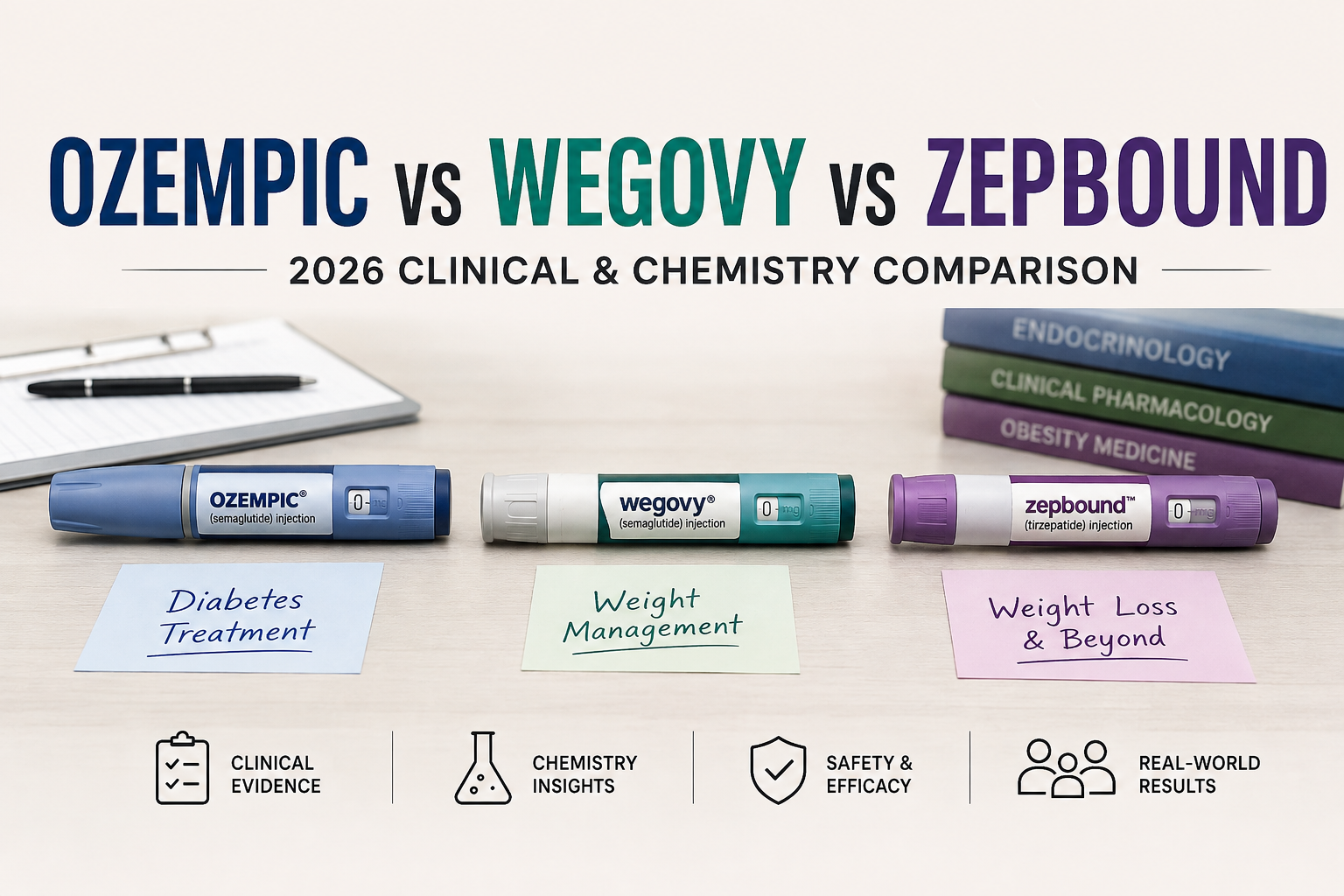
If you’ve been searching for Ozempic, Wegovy, or Zepbound, you’ve probably seen these three names mentioned together. That’s understandable—they’re all part of the same GLP-1-based treatment conversation. But they aren’t the same medicine.
Ozempic and Wegovy contain semaglutide. Zepbound contains tirzepatide, a different molecule that acts on both GIP and GLP-1 receptors.
That difference starts with the chemistry and carries through to the way these drugs work, their approved uses, dosing, and the results seen in clinical trials. So comparing the three only by their brand names doesn’t tell us very much.
The comparison is also more interesting in 2026, with newer formulations and expanded clinical uses adding to an already fast-moving field. Current FDA information reflects these changes, so older articles can leave out important details.
With my MSc in Chemistry and more than 13 years of experience in the pharmaceutical industry, I want to look at these medicines from both angles: what their molecules do in the body and what clinical research has actually shown in patients.
That means going beyond the usual “Which one is best?” question and looking at semaglutide vs. tirzepatide, chemistry, approved uses, dosing, weight-loss results, and safety.
Quick Answer
Ozempic and Wegovy contain semaglutide, while Zepbound contains tirzepatide. Semaglutide acts on the GLP-1 receptor. Tirzepatide acts on both GIP and GLP-1 receptors, giving the two molecules different pharmacological profiles.
Their FDA-approved uses are also different, so they shouldn’t be treated as interchangeable just because all three are commonly discussed for weight loss. Ozempic is approved for type 2 diabetes, while Wegovy and Zepbound have weight-management indications. Zepbound is also approved for moderate-to-severe obstructive sleep apnea in adults with obesity.
When it comes specifically to weight loss, tirzepatide produced greater average weight reduction than semaglutide in the 72-week SURMOUNT-5 trial. Participants receiving tirzepatide lost an average of 20.2% of their body weight, compared with 13.7% with semaglutide.
That result is useful, but it isn’t a guarantee of what any particular person will experience. The choice between these medicines also depends on the treatment goal, medical history, tolerability, dosing, and the product’s approved use.
Quick Comparison: Ozempic vs Wegovy vs Zepbound
| Feature | Ozempic | Wegovy | Zepbound |
|---|---|---|---|
| Active ingredient | Semaglutide | Semaglutide | Tirzepatide |
| Molecular targets | GLP-1 receptor | GLP-1 receptor | GIP + GLP-1 receptors |
| FDA-approved uses | Type 2 diabetes; cardiovascular and kidney risk reduction in specific patients | Weight management; cardiovascular risk reduction in certain adults; MASH with moderate-to-advanced fibrosis | Chronic weight management; moderate-to-severe obstructive sleep apnea in adults with obesity |
| Same molecule as Ozempic? | — | Yes | No |
| Drug type | GLP-1 receptor agonist | GLP-1 receptor agonist | GIP/GLP-1 receptor agonist |
The simplest distinction is this: Ozempic and Wegovy use the same molecule, semaglutide. Zepbound uses tirzepatide, which targets two incretin pathways instead of one.
The table is only the quick view. The exact approved indications, formulations, and dosing are more detailed, and the 2026 FDA prescribing information is used for those sections rather than relying on older drug-comparison pages. FDA — Ozempic Prescribing Information FDA — Wegovy Prescribing Information FDA — Zepbound Prescribing Information
What Are Ozempic, Wegovy and Zepbound?
Ozempic: Semaglutide
Ozempic contains semaglutide, a modified peptide that activates the GLP-1 receptor. It is FDA-approved to improve blood-glucose control in adults with type 2 diabetes and has additional indications related to cardiovascular and kidney risk in specific patients. FDA — Ozempic Prescribing Information
For this comparison, the important fact is straightforward: the active molecule in Ozempic is semaglutide.
Wegovy: The Same Molecule
Wegovy also contains semaglutide. So from a chemistry standpoint, Ozempic and Wegovy are built around the same active molecule.
Their differences come from the approved indications, formulations, and dosing framework, rather than from having two completely different active ingredients. Current FDA labeling includes both injectable and oral Wegovy formulations. FDA — Wegovy Prescribing Information
That makes the Ozempic-versus-Wegovy comparison quite different from the comparison with Zepbound.
Zepbound: Tirzepatide
Zepbound contains tirzepatide, a different modified peptide.
Tirzepatide activates GIP and GLP-1 receptors, whereas semaglutide primarily activates the GLP-1 receptor. Those receptor targets are not just labels on a drug chart; they describe how the molecules interact with the body’s incretin system.
The FDA identifies tirzepatide as Zepbound’s active ingredient and recognizes its approved uses in chronic weight management and obstructive sleep apnea in adults with obesity. FDA — Zepbound Prescribing Information
So the basic chemistry can be remembered in three lines:
Ozempic → Semaglutide → GLP-1
Wegovy → Semaglutide → GLP-1
Zepbound → Tirzepatide → GIP + GLP-1
That difference in molecular structure and receptor activity is where the deeper comparison begins. The next section looks at what these molecules actually do at the receptor level—and why that matters clinically.
The Chemistry Behind Ozempic, Wegovy and Zepbound
Semaglutide: The Molecule Behind Ozempic and Wegovy
Semaglutide is a GLP-1 receptor agonist and a modified analogue of human GLP-1. Its amino-acid sequence has approximately 94% homology with human GLP-1. FDA — Wegovy Prescribing Information
The interesting part from a pharmaceutical chemistry perspective is not simply that semaglutide resembles GLP-1. It is how specific chemical changes were made to the peptide.
Natural GLP-1 is broken down rapidly in the body, including by the enzyme DPP-4, which limits its useful duration. Semaglutide was designed with structural modifications that make it much more suitable as a long-acting medicine.
One of these changes replaces the alanine at position 8 with α-aminoisobutyric acid (Aib). This modification helps reduce susceptibility to DPP-4-mediated degradation. Another modification changes the amino acid at position 34 from lysine to arginine. The lysine at position 26 is then chemically modified with a C18 fatty diacid through a linker containing γ-glutamic acid and ethylene glycol units.
That fatty-acid side chain has an important job. It allows semaglutide to bind reversibly to human serum albumin in the bloodstream. Albumin is abundant in plasma, so this interaction helps slow the molecule’s clearance and contributes to its long duration of action.
In other words, semaglutide was not made long-acting by simply making the peptide larger. Its structure was deliberately modified at several positions to protect the peptide and change its pharmacokinetic behavior.
That is a good example of medicinal chemistry doing exactly what it is supposed to do: taking a naturally occurring biological signal and redesigning the molecule so that it can function as a practical medicine.
Tirzepatide: A Different Molecular Design
Zepbound contains tirzepatide, a different synthetic peptide with activity at both the GIP receptor and GLP-1 receptor. The molecule contains 39 amino acids and was designed with structural features that allow it to interact with both incretin systems.
Tirzepatide also carries a lipid modification, but its chemistry is not identical to semaglutide’s. A C20 fatty diacid is attached to lysine at position 20 through a linker containing γ-glutamic acid and two OEG units. This lipid modification promotes albumin binding and helps extend the peptide’s half-life.
There is another interesting structural detail. Tirzepatide contains α-aminoisobutyric acid (Aib) at position 2, which contributes to resistance against enzymatic degradation.
So tirzepatide is not simply a higher-dose or “stronger” version of semaglutide. The molecules are chemically different, their receptor targets are different, and their structures have been engineered in different ways to achieve prolonged activity.
The Molecular Difference at a Glance
| Medicine | Active molecule | Main receptor activity | Key structural feature |
|---|---|---|---|
| Ozempic | Semaglutide | GLP-1 receptor | C18 fatty diacid for albumin binding |
| Wegovy | Semaglutide | GLP-1 receptor | Same active molecule as Ozempic |
| Zepbound | Tirzepatide | GIP + GLP-1 receptors | C20 fatty diacid for albumin binding |
So the chemistry gives us a clean starting point:
Ozempic = semaglutide
Wegovy = semaglutide
Zepbound = tirzepatide
The difference is much deeper than the brand name. Semaglutide and tirzepatide are engineered peptide molecules with different structures, different receptor activity, and different pharmacokinetic designs.
Clinical trials then tell us something chemistry alone cannot: how those molecular differences translate into outcomes in actual patients.
What Does the Clinical Evidence Actually Show?
The clearest head-to-head evidence comes from the SURMOUNT-5 trial, published in the New England Journal of Medicine in 2025. The trial included 751 adults with obesity who did not have type 2 diabetes and compared once-weekly tirzepatide with semaglutide over 72 weeks. New England Journal of Medicine — SURMOUNT-5
The results showed a clear difference in average weight loss.
After 72 weeks, participants taking tirzepatide lost an average of 20.2% of their body weight, compared with 13.7% with semaglutide. Waist circumference fell by an average of 18.4 cm with tirzepatide and 13.0 cm with semaglutide.
Those numbers are useful, but they need to stay in context.
The trial involved a specific group of adults, a defined treatment period, and controlled dosing conditions. 20.2% is the average result for the tirzepatide group, not a promise that every person taking tirzepatide will lose 20.2% of their body weight.
People respond differently to these medicines. Tolerability, dose, treatment duration, adherence, and individual health factors can all affect the result.
So the answer to one very specific question is straightforward:
In SURMOUNT-5, tirzepatide produced greater average weight loss than semaglutide.
That gives us an important clinical result to put beside the chemistry we discussed earlier. Semaglutide and tirzepatide are different molecules with different receptor activity, and this trial found a meaningful difference in average weight reduction.
Weight loss isn’t the only consideration, though. Approved indications, dosing, side effects, tolerability, cost, and the patient’s medical situation all have a place in the treatment decision.
Ozempic vs Wegovy vs Zepbound: The FDA-Approved Uses Are Not the Same
The three products are often grouped together because they are all discussed in the context of metabolic health and weight loss. Their FDA-approved indications, however, are not identical.
Ozempic contains semaglutide and is approved to improve blood-glucose control in adults with type 2 diabetes. Its labeling also includes cardiovascular risk reduction in adults with type 2 diabetes and established cardiovascular disease, and reduction of certain kidney and cardiovascular risks in adults with type 2 diabetes and chronic kidney disease. FDA — Ozempic Prescribing Information
Wegovy also contains semaglutide, but its approved uses are different. Current FDA labeling includes chronic weight management, reduction of major cardiovascular events in certain adults with cardiovascular disease and overweight or obesity, and treatment of noncirrhotic metabolic dysfunction-associated steatohepatitis (MASH) with moderate-to-advanced fibrosis (F2–F3). The 2026 label also covers both injectable and oral formulations. FDA — Wegovy Prescribing Information
Zepbound contains tirzepatide and is approved for chronic weight management in adults with obesity or adults who are overweight with at least one weight-related condition. It also has an FDA-approved indication for moderate-to-severe obstructive sleep apnea in adults with obesity. FDA — Zepbound Prescribing Information
That makes the comparison more precise:
Ozempic → Type 2 diabetes + specific cardiovascular and kidney risk indications
Wegovy → Weight management + specific cardiovascular and MASH indications
Zepbound → Weight management + obstructive sleep apnea in adults with obesity
And because Ozempic and Wegovy contain the same active molecule, the difference between those two products is not simply a chemistry question. The approved indication, formulation, dose, and clinical context all matter.
Weight loss can affect more than the number on the scale. Changes in body-fat distribution can sometimes be noticeable in unexpected areas as well. We explain this in more detail in our guide to Ozempic Face: Causes, Prevention & What Actually Works.
How Do the Doses Differ?
The numbers can look confusing when these medicines are placed side by side. They should not be compared milligram-for-milligram, because semaglutide and tirzepatide are different molecules.
Ozempic Dosing
Ozempic is started at 0.25 mg once weekly for four weeks. The dose can then be increased to 0.5 mg once weekly, with further increases to 1 mg or 2 mg once weekly when additional glycemic control is needed. The starting dose is intended for treatment initiation rather than long-term glycemic control.
Wegovy Dosing
Wegovy injection also begins at a low dose and is increased gradually to improve tolerability. For adults using the injection for chronic weight management, the recommended maintenance dose is generally 2.4 mg once weekly, provided it is tolerated. Current FDA labeling also includes an oral Wegovy formulation, which follows a different dosing schedule.
Zepbound Dosing
Zepbound starts at 2.5 mg once weekly for four weeks. For chronic weight management, the recommended maintenance doses are 5 mg, 10 mg, or 15 mg once weekly, depending on the individual’s response and tolerability. The 2.5 mg dose is intended for treatment initiation and is not a maintenance dose.
Why the Milligram Numbers Cannot Be Compared Directly
One point is worth remembering when looking at these numbers:
2.4 mg of semaglutide cannot be directly compared with 15 mg of tirzepatide.
A milligram is simply a unit of mass. It does not tell us that one drug is “stronger” than another. The molecules have different structures, receptor activity, pharmacology, and dosing requirements.
And if you’re wondering whether Ozempic can be divided into more than one weekly dose, we’ve already looked at that specific question in Can I Split My Ozempic Dose to Twice a Week?.
The practical rule is simple: use the dosing schedule established for the specific medicine rather than trying to make the doses of different drugs match.
Side Effects: Where the Medicines Have More in Common
Ozempic, Wegovy, and Zepbound have several gastrointestinal side effects in common. Nausea, diarrhea, vomiting, constipation, and abdominal pain are among the commonly reported adverse effects, particularly during dose escalation.
These effects don’t occur in everyone, and their severity can vary from person to person.
The prescribing information also includes warnings about more serious problems, including pancreatitis, acute gallbladder disease, kidney injury related to volume depletion, and severe gastrointestinal reactions. The specific warnings and contraindications differ between products, so the prescribing information for the medicine being used is the appropriate reference.
That is one reason weight-loss results should not be considered on their own. A treatment also needs to be appropriate and tolerable for the individual patient.
If severe or persistent symptoms develop, don’t change the dose on your own. Discuss the symptoms with the healthcare professional managing the treatment.
Which One Causes More Weight Loss?
If we look specifically at the results from the SURMOUNT-5 trial, tirzepatide produced greater average weight loss than semaglutide.
Over 72 weeks, adults with obesity who did not have type 2 diabetes lost an average of 20.2% of their body weight with tirzepatide, compared with 13.7% with semaglutide. Waist circumference also decreased more with tirzepatide. New England Journal of Medicine — SURMOUNT-5
These are average results, not guarantees for every patient. Individual response can vary, and tolerability, adherence, dose, and treatment duration can all affect the outcome.
Because Ozempic and Wegovy both contain semaglutide, the head-to-head comparison in this trial can be summarized simply:
Semaglutide → 13.7% average weight loss
Tirzepatide → 20.2% average weight loss
So, in SURMOUNT-5, tirzepatide produced greater average weight loss than semaglutide.
Weight loss can affect more than the number on the scale. Changes in body-fat distribution can sometimes be noticeable in unexpected areas as well. For more on this, see our guide to Ozempic Vulva: What It Means, Why It Happens & What to Know
Which One May Make More Sense for You?
There isn’t one winner for everybody.
Someone managing type 2 diabetes may have a very different treatment goal from someone whose main concern is obesity and long-term weight management. Ozempic has specific FDA-approved uses for type 2 diabetes, while Wegovy and Zepbound have FDA-approved indications for chronic weight management.
The numbers from SURMOUNT-5 are still worth remembering. Tirzepatide produced greater average weight loss than semaglutide in that study. 20.2% versus 13.7% after 72 weeks.
Real life is less predictable than a clinical-trial table.
One person may lose a substantial amount of weight with semaglutide and tolerate it well. Another may struggle with nausea or other gastrointestinal effects. Someone else may respond better to tirzepatide.
Then there are the practical things: cost, insurance coverage, dose availability, other medicines, existing health problems, and how well the treatment is tolerated.
So I wouldn’t choose between these medicines from the weight-loss percentage alone.
Track Your Progress at Home
If you’re working on weight management, tracking your weight consistently can help you see how your progress changes over time.
Etekcity Smart Scale — tracks body weight, BMI, muscle mass and other body-composition measurements, with app connectivity and Apple Health support.
👉 Check the Etekcity Smart Scale on Amazon
As an Amazon Associate, MedicalBluff earns from qualifying purchases.
That is where the decision should ultimately be made—with a qualified healthcare professional who knows the person’s medical history and treatment goals.
Can You Switch Between Ozempic, Wegovy and Zepbound?
Switching between these medicines isn’t simply a matter of choosing a different pen.
Ozempic and Wegovy both contain semaglutide, while Zepbound contains tirzepatide. Switching to Zepbound therefore means changing to a different active molecule, while switching between Ozempic and Wegovy involves different products containing the same active ingredient.
The dose matters too. Each medicine has its own starting dose and dose-escalation schedule. A dose from one medicine should not simply be carried over to another.
The same applies to dosing frequency. Taking Ozempic more often than prescribed is not a simple way to divide the weekly dose.
Any switch should therefore be planned with the prescribing healthcare professional rather than treated as a straightforward brand change.
The important questions are: Why is the switch being considered? How has the current medicine been tolerated? What dose is appropriate? And what is the treatment intended to achieve?
Those factors matter more than simply choosing the medicine with the highest number on a weight-loss chart.
Ozempic vs Wegovy vs Zepbound: The Bottom Line
The chemistry and clinical evidence give us a clearer picture of how these medicines differ.
Ozempic and Wegovy contain semaglutide, while Zepbound contains tirzepatide. In the direct SURMOUNT-5 comparison, tirzepatide produced greater average weight loss than semaglutide over 72 weeks: 20.2% versus 13.7%.
That result does not mean tirzepatide is automatically the right choice for everyone. Treatment goals, tolerability, side effects, other health conditions, other medicines, cost, and individual response all matter.
The chemistry explains why the molecules are different. Clinical trials show how those differences can translate into outcomes. Neither tells us exactly what will happen to every individual.
So, tirzepatide currently has the stronger head-to-head weight-loss result, while semaglutide remains an established treatment with different FDA-approved products and uses.
The final choice should be based on the individual’s medical situation and treatment goals, together with guidance from the healthcare professional managing the treatment.
Frequently Asked Questions
Are Ozempic and Wegovy the same drug?
They contain the same active molecule, semaglutide, but they are different FDA-approved products with different approved uses, dosing, and formulations.
Is Zepbound the same as Ozempic?
No. Ozempic contains semaglutide, while Zepbound contains tirzepatide. Semaglutide primarily activates the GLP-1 receptor, while tirzepatide activates both GIP and GLP-1 receptors.
Which causes more weight loss, Wegovy or Zepbound?
In the 72-week SURMOUNT-5 trial, tirzepatide produced greater average weight loss than semaglutide: 20.2% versus 13.7%. Individual results can differ.
Can Ozempic be used for weight loss?
Ozempic is FDA-approved for type 2 diabetes and specific cardiovascular and kidney risk-reduction indications, rather than chronic weight management. Wegovy is the semaglutide product with an FDA-approved chronic weight-management indication.
Is Zepbound stronger than semaglutide?
Calling one molecule simply “stronger” isn’t scientifically useful. They are different molecules with different structures and receptor activity. Tirzepatide produced greater average weight loss in SURMOUNT-5, but that does not predict an individual’s response.
Can I switch from Ozempic to Wegovy or Zepbound?
A switch may be appropriate in some circumstances, but it should be planned with the prescribing healthcare professional. The medicines have different dosing schedules and should not be treated as interchangeable injections.
Which one has fewer side effects?
There is no single answer for everyone. Nausea, vomiting, diarrhea, constipation, and other gastrointestinal effects can occur with both semaglutide and tirzepatide, and individual tolerability varies.
Is Zepbound only for weight loss?
No. Zepbound is also FDA-approved for moderate-to-severe obstructive sleep apnea in adults with obesity, in addition to chronic weight management.
So which one is best?
There is no universal winner. The appropriate choice depends on the person’s medical condition, treatment goal, response, tolerability, and other medicines.
Final Takeaway
Ozempic, Wegovy, and Zepbound may often appear together in weight-loss discussions, but they are not the same medicine.
Ozempic and Wegovy contain semaglutide, while Zepbound contains tirzepatide. That difference affects their receptor activity, approved uses, dosing, and clinical effects.
In the direct SURMOUNT-5 comparison, tirzepatide produced greater average weight loss than semaglutide after 72 weeks: 20.2% versus 13.7%.
But that result does not make one medicine automatically right for everyone. Treatment goal, medical history, tolerability, other medicines, and approved use all matter.
The useful way to understand this comparison is to look beyond the brand names and consider the molecules, pharmacology, and clinical evidence behind them.