



COPD Spirometry Results Explained: FEV1/FVC, Graphs, GOLD Stages & Examples
Imagine receiving a lung function report with an FEV1 of 57% predicted and an FEV1/FVC ratio of 0.55. The report contains numbers, percentages and medical terms, but what do they actually tell you? Does the ratio confirm COPD? Does 57% predicted mean that 57% of the lungs are working?
These are reasonable questions. Spirometry is one of the most important tests used to confirm chronic obstructive pulmonary disease (COPD), yet its results can be difficult to understand without knowing what each measurement represents.
This guide takes a practical approach. Rather than simply listing lung function terms, it walks through a sample spirometry report, explains how to read common graphs, compares asthma and COPD patterns, and shows how GOLD airflow limitation grades differ from the broader assessment of COPD.
Quick Answer: What Does Spirometry Show in COPD?
Spirometry measures how much air a person can forcefully breathe out and how quickly it leaves the lungs.
Three measurements are especially important:
- FEV1: The volume of air exhaled during the first second of a forced breath.
- FVC: The total volume of air forcefully exhaled after taking a deep breath.
- FEV1/FVC ratio: FEV1 divided by FVC. It helps identify airflow obstruction.
According to the 2026 Global Initiative for Chronic Obstructive Lung Disease (GOLD) guidance, COPD is confirmed by a post-bronchodilator FEV1/FVC ratio below 0.70, when the person’s symptoms and exposure history support the diagnosis.
After COPD is confirmed, post-bronchodilator FEV1 as a percentage of its predicted value helps classify airflow limitation into GOLD grades 1–4.
These grades describe airflow limitation. They do not tell the whole story about a person’s symptoms, daily activities or overall health.
What Is Spirometry and Why Is It Used for COPD?
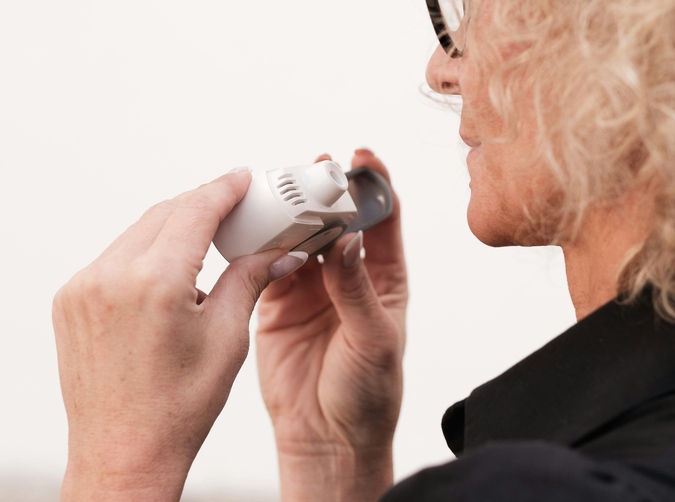
Spirometry is a breathing test that measures the volume of air a person can forcefully exhale and the speed at which they can do it.
During the test, a person takes a deep breath, seals their lips around a mouthpiece and blows out as hard and fast as possible. They continue exhaling until the technician asks them to stop. The manoeuvre is usually repeated to obtain acceptable and repeatable measurements.
In COPD, the airways become narrowed or damaged, making it harder to move air out of the lungs. Spirometry can detect the resulting airflow obstruction.
A healthcare professional may request the test when someone has:
- Persistent breathlessness, particularly during activity
- A long-term cough
- Regular sputum or mucus production
- Repeated respiratory infections
- A history of tobacco smoke, biomass smoke, occupational dust, air pollution or other harmful inhaled exposures
These symptoms do not prove COPD. Asthma, heart disease and other respiratory conditions can cause similar problems. A clinical assessment helps determine whether spirometry is appropriate and how its results should be interpreted.
Why Is Spirometry Performed Before and After a Bronchodilator?
A bronchodilator is a medicine that relaxes the muscles surrounding the airways and helps open them.
During a diagnostic assessment, spirometry may be performed before and after a bronchodilator. The post-bronchodilator result is particularly important for COPD diagnosis because it shows whether airflow obstruction remains after the medicine has had time to work.
If the post-bronchodilator FEV1/FVC ratio remains below 0.70, it meets the spirometric criterion used by GOLD to confirm COPD in the appropriate clinical context.
However, improvement after a bronchodilator does not automatically rule out COPD. Some people with COPD show measurable improvement in FEV1 or FVC after receiving the medicine.
FEV1, FVC and FEV1/FVC Ratio Explained
A spirometry report may contain several measurements, but three deserve particular attention.
What Is FEV1?
FEV1 stands for forced expiratory volume in one second.
It measures how much air a person can forcefully breathe out during the first second of a forced exhalation.
Think of it as a measurement of how quickly air leaves the lungs. When the airways narrow, airflow becomes limited and the volume exhaled during that first second may decrease.
Reports usually show FEV1 in litres (L). They may also show it as a percentage of the predicted value for a person with similar reference characteristics.
For example, an FEV1 of 1.65 L might be reported as 57% predicted. This means the measured value is 57% of the reference value used for comparison. It does not mean that 57% of the lungs are working.
What Is FVC?
FVC stands for forced vital capacity.
It is the total volume of air a person forcefully exhales after taking the deepest possible breath.
Unlike FEV1, which measures the first second, FVC measures the total volume exhaled during the forced manoeuvre.
For example, if someone forcefully exhales 3.0 litres in total, their FVC is 3.0 L.
What Does the FEV1/FVC Ratio Mean?
The FEV1/FVC ratio compares the volume exhaled during the first second with the total volume exhaled.
The calculation is:
FEV1/FVC = FEV1 ÷ FVC
Consider this example:
- FEV1: 1.65 L
- FVC: 3.00 L
- FEV1/FVC: 1.65 ÷ 3.00 = 0.55, or 55%
This means that 55% of the measured forced vital capacity was exhaled during the first second.
A reduced ratio can indicate airflow obstruction. GOLD uses a post-bronchodilator ratio below 0.70 as its spirometric criterion for COPD in the appropriate clinical setting.
One important detail: the ratio is not the same as FEV1 percentage predicted. The ratio compares two measured volumes, while FEV1 percentage predicted compares a measured volume with a reference value.
FEV1, FVC and FEV1/FVC: What Is the Difference?
| Measurement | What it measures | Why it matters |
|---|---|---|
| FEV1 | Air exhaled during the first second | Helps assess airflow limitation |
| FVC | Total air exhaled during the forced manoeuvre | Shows the total forced exhaled volume |
| FEV1/FVC | FEV1 divided by FVC | Helps identify an obstructive pattern |
How to Read a COPD Spirometry Graph
A spirometry report may include a flow-volume loop or a volume-time curve. These graphs show how air moves during the breathing manoeuvre.
Understanding their basic shapes can make a report less intimidating.
Normal Flow-Volume Loop
In a typical normal flow-volume loop, airflow rises quickly during forced exhalation, reaches a peak and then gradually falls as the lungs empty.
The expiratory part of the loop usually has a relatively smooth downward shape.
Obstructive Flow-Volume Loop
With airflow obstruction, the expiratory portion of the loop often develops a characteristic scooped-out or concave appearance.
This shape reflects reduced expiratory airflow, particularly as the lungs continue to empty.
COPD can produce this pattern, but the shape alone cannot diagnose the condition. The measured values, test quality and clinical history remain essential.
MedicalBluff graphic idea: A side-by-side comparison of a normal flow-volume loop and an obstructive loop, with the expiratory portions clearly labelled.
Suggested image alt text: Normal versus obstructive COPD spirometry flow-volume loop showing reduced expiratory airflow.
What Does a Volume-Time Curve Show?
A volume-time curve displays the volume of air exhaled against time.
- The early steep rise represents rapid air exhalation.
- The first-second measurement contributes to FEV1.
- The curve continues rising as more air leaves the lungs.
- It eventually approaches a plateau when the exhaled volume stops increasing significantly.
The curve helps the clinician assess the breathing manoeuvre and the relationship between FEV1 and FVC.
An incomplete breath, early termination or an inadequate effort can affect the result. This is why trained staff assess test quality rather than relying on the printed graph alone.
COPD Spirometry Results Example: A Report Walkthrough
This is the practical part of the guide. The following report uses fictional measurements to demonstrate how common spirometry values relate to one another.
It is an educational example, not a real patient report or a diagnostic tool.
Hypothetical Spirometry Report
| Measurement | Example result |
|---|---|
| Post-bronchodilator FEV1 | 1.65 L |
| FEV1 predicted | 2.90 L |
| FEV1 % predicted | 57% |
| Post-bronchodilator FVC | 3.00 L |
| FVC predicted | 3.75 L |
| FVC % predicted | 80% |
| Post-bronchodilator FEV1/FVC | 0.55 |
Step 1: Check FEV1
The measured FEV1 is 1.65 L, while the predicted value in this fictional report is 2.90 L.
To calculate FEV1 percentage predicted:
(Measured FEV1 ÷ Predicted FEV1) × 100
(1.65 ÷ 2.90) × 100 = approximately 57%
The measured first-second exhaled volume is therefore 57% of the predicted reference value.
Step 2: Check FVC
The measured FVC is 3.00 L, compared with a predicted value of 3.75 L.
The calculation is:
(3.00 ÷ 3.75) × 100 = 80% predicted
This describes the total forced exhaled volume in relation to the predicted value.
Step 3: Calculate FEV1/FVC
Now divide FEV1 by FVC:
1.65 ÷ 3.00 = 0.55
The ratio is 0.55, or 55%.
If this is a valid post-bronchodilator result, it is below the GOLD threshold of 0.70 and demonstrates persistent airflow obstruction.
Step 4: What Could the FEV1 Percentage Predicted Suggest?
If COPD is confirmed and the post-bronchodilator FEV1 is 57% predicted, this falls within GOLD grade 2 (moderate airflow limitation).
That grade describes the degree of airflow limitation. It does not tell us how breathless the person feels, whether they can walk comfortably or how often they experience flare-ups.
What this example cannot tell us: It cannot establish the person’s diagnosis, treatment needs or overall disease severity. A real report must be interpreted with test quality, symptoms, exposure history and other clinical findings.
FEV1 Normal Range: Does Age Matter?
There is no single FEV1 value in litres that applies to every adult.
Expected lung function varies with characteristics such as age, height and sex. Spirometry software compares measured values with reference equations to estimate the predicted value.
That is why two people can have different FEV1 values in litres and still fall within their respective reference ranges.
What Does FEV1 % Predicted Mean?
FEV1 percentage predicted compares the measured FEV1 with the predicted reference value.
For example:
- Measured FEV1: 2.0 L
- Predicted FEV1: 3.0 L
- FEV1 % predicted: approximately 67%
The result is approximately 67% predicted.
This percentage helps classify airflow limitation in confirmed COPD, but it should not be used alone to diagnose the condition.
What Is the Lower Limit of Normal (LLN)?
The lower limit of normal, or LLN, is a statistical reference point used to identify measurements below the expected range for a relevant reference population.
Spirometry interpretation may also use a z-score. It shows how far a measured result lies from the predicted reference value in standard deviation units.
Modern lung function interpretation can use appropriate race-neutral reference equations, including the Global Lung Function Initiative (GLI) Global equations.
There is an important distinction here:
- GOLD uses a fixed post-bronchodilator FEV1/FVC ratio below 0.70 to confirm COPD-related airflow obstruction in the appropriate clinical context.
- LLN and z-scores provide additional reference information, including how a result compares with expected values for a person’s age and other characteristics.
Neither approach should be interpreted without considering symptoms, exposure history and test quality.
FEV1/FVC Ratio in Asthma vs COPD: What Is the Difference?
Asthma and COPD can both cause airflow obstruction. This means their spirometry results can sometimes look similar.
However, the pattern of symptoms and airflow limitation over time can differ.
Spirometry in COPD
COPD generally involves persistent airflow obstruction. The post-bronchodilator FEV1/FVC ratio may remain below 0.70.
The condition is often associated with long-term exposure to tobacco smoke, biomass fuel smoke, workplace dust or other harmful inhaled substances.
Spirometry in Asthma
Asthma is associated with variable respiratory symptoms and variable expiratory airflow limitation.
A person with asthma may show an obstructive pattern during symptomatic periods, while spirometry may be closer to normal at other times.
A measurable improvement after a bronchodilator can support the assessment of variable airflow limitation, but the result needs clinical interpretation.
Can a Bronchodilator Test Distinguish Asthma from COPD?
Not reliably on its own.
Some people with COPD show a bronchodilator response, and some people with asthma may not show a significant response during a particular test.
The amount of improvement in FEV1 or FVC after a bronchodilator does not independently establish which disease a person has.
Clinicians consider symptom patterns, medical history, exposure history, spirometry and other investigations when the distinction remains uncertain.
COPD Stages: Understanding GOLD Grades 1–4
People commonly search for COPD stages when they want to understand how severe their airflow obstruction is.
GOLD classifies airflow limitation into four grades using post-bronchodilator FEV1 as a percentage of the predicted value.
These grades apply to people who already meet the spirometric definition of COPD, including a post-bronchodilator FEV1/FVC ratio below 0.70.
| GOLD grade | Airflow limitation | Post-bronchodilator FEV1 |
|---|---|---|
| GOLD 1 | Mild | ≥80% predicted |
| GOLD 2 | Moderate | ≥50% and <80% predicted |
| GOLD 3 | Severe | ≥30% and <50% predicted |
| GOLD 4 | Very severe | <30% predicted |
GOLD 1: Mild Airflow Limitation
FEV1 is at least 80% of the predicted value.
A person may still experience cough, sputum production or breathlessness. A relatively preserved FEV1 does not mean that symptoms should be ignored.
GOLD 2: Moderate Airflow Limitation
FEV1 is at least 50% but below 80% predicted.
Some people notice breathlessness during activities such as walking uphill or climbing stairs. Symptoms vary from person to person.
GOLD 3: Severe Airflow Limitation
FEV1 is at least 30% but below 50% predicted.
Airflow limitation is more pronounced, and some people experience considerable difficulty with physical activity.
GOLD 4: Very Severe Airflow Limitation
FEV1 is below 30% predicted.
This grade represents very severe airflow limitation. A person’s overall health, symptoms, oxygen levels, exacerbations and other conditions still need separate assessment.
Are GOLD Grades and GOLD A/B/E Groups the Same?
No. They answer different questions.
- GOLD 1–4 describes the degree of airflow limitation measured by spirometry.
- GOLD A/B/E groups patients according to symptom burden and exacerbation history.
The A/B/E assessment helps clinicians understand the impact of COPD and the risk of future exacerbations. It is not another name for the FEV1 grades.
Under the 2026 GOLD approach, Group E includes people with at least one moderate or severe exacerbation in the previous year.
A person can therefore have GOLD 2 airflow limitation and belong to Group B or E, depending on their symptoms and exacerbation history.
COPD ICD-10-CM Codes: What Do They Mean?
The term COPD ICD-10 is commonly searched by people looking for diagnosis or medical billing codes.
For US readers, the relevant system is ICD-10-CM, the clinical modification used for diagnosis coding. The code depends on the documented condition and circumstances.
Commonly used US ICD-10-CM codes include:
| Code | Description |
|---|---|
| J44.0 | COPD with acute lower respiratory infection |
| J44.1 | COPD with acute exacerbation |
| J44.89 | Other specified COPD |
| J44.9 | COPD, unspecified |
For J44.0, an additional code is used to identify the associated infection when applicable.
These codes are not interchangeable. A COPD diagnosis alone does not automatically mean that an acute exacerbation or lower respiratory infection is present.
The code must match the healthcare provider’s documentation and the applicable coding rules. The US ICD-10-CM system should not be assumed to represent every country’s ICD-10 system.
Coding update: The current US fiscal-year 2027 ICD-10-CM code set became effective on October 1, 2026. Always check the code set that applies to the date of service.
Why Can COPD Spirometry Results Be Borderline?
Not every spirometry result gives a clear answer.
A post-bronchodilator FEV1/FVC ratio close to 0.70 may need closer assessment, particularly when symptoms and medical history suggest COPD.
The 2026 GOLD/GLI joint statement highlights measurement uncertainty and biological variation. It discusses a range around 0.60–0.80 in which further investigation or repeat measurements may be appropriate, depending on the clinical situation.
Consider an older adult with a post-bronchodilator FEV1/FVC ratio of 0.65. The result is below GOLD’s fixed 0.70 threshold, but it may be above the person’s age-related lower limit of normal.
This does not mean the GOLD criterion should simply be ignored. It means the clinician may need to consider the person’s symptoms, exposure history, reference values and the possibility of measurement variation before making a firm conclusion.
Other reasons for an uncertain result include:
- An incomplete or poorly performed breathing manoeuvre
- Differences between pre- and post-bronchodilator measurements
- Biological variation between tests
- Symptoms that do not match the degree of airflow obstruction
- Other lung or heart conditions that may explain the symptoms
A borderline result should not automatically confirm COPD, but it should not be dismissed when symptoms or relevant exposures remain concerning.
When Should Spirometry Results Be Reviewed or Repeated?
A clinician may recommend repeat spirometry or additional investigations when:
- The result is close to the diagnostic threshold.
- The breathing manoeuvre did not meet quality standards.
- Symptoms remain unexplained despite a result that does not show obstruction.
- Pre- and post-bronchodilator results differ in a clinically important way.
- The measured airflow limitation does not appear to match the person’s symptoms.
Depending on the situation, further evaluation may include lung-volume measurements, diffusing capacity testing, imaging or assessment for other conditions.
Spirometry is an important part of COPD assessment, but it does not measure every aspect of lung health. Other respiratory conditions, including pneumonitis, may require a different diagnostic approach.
Questions to Ask Your Respiratory Specialist About a Spirometry Report
If you have received a spirometry report, these questions may help you understand the findings during your appointment:
- Was my spirometry test technically acceptable and repeatable?
- What were my pre- and post-bronchodilator FEV1/FVC ratios?
- What are my FEV1 and FVC percentages predicted?
- Does my result meet the spirometric criterion for COPD?
- Is my result close to the diagnostic threshold?
- What GOLD airflow limitation grade applies, if COPD is confirmed?
- Do my symptoms suggest that I need additional investigations?
These questions can help make the appointment more useful without trying to diagnose the condition from the report alone.
Frequently Asked Questions About COPD Spirometry
What is a normal FEV1/FVC ratio? + There is no single interpretation that applies to every person. GOLD uses a post-bronchodilator FEV1/FVC ratio below 0.70 as its spirometric criterion for COPD in the appropriate clinical context. Reference values and the lower limit of normal can provide additional information.
What FEV1/FVC ratio indicates COPD? + A post-bronchodilator FEV1/FVC ratio below 0.70 meets the GOLD spirometric criterion for airflow obstruction. A clinician must also consider symptoms, exposure history and other clinical findings before diagnosing COPD.
Can spirometry confirm COPD? + Yes. Spirometry is required to establish COPD under GOLD guidance. The diagnostic criterion is persistent airflow obstruction demonstrated by a post-bronchodilator FEV1/FVC ratio below 0.70 in the appropriate clinical context.
What is a moderate COPD spirometry result? + For someone with confirmed COPD, GOLD grade 2 (moderate airflow limitation) corresponds to a post-bronchodilator FEV1 of at least 50% but below 80% predicted.
What is the difference between GOLD 2 and GOLD 3 COPD? + GOLD 2 represents moderate airflow limitation, with FEV1 between 50% and below 80% predicted. GOLD 3 represents severe airflow limitation, with FEV1 between 30% and below 50% predicted.
Can asthma and COPD have the same spirometry results? + They can show overlapping obstructive patterns. A bronchodilator response may occur in either condition, so spirometry alone cannot always distinguish asthma from COPD. Clinical history and other findings are important.
Does a normal spirometry result rule out every lung disease? + No. Spirometry measures particular aspects of airflow and forced breathing. Some lung conditions may require other tests, such as lung-volume measurements, diffusion testing or imaging.
What does COPD ICD-10-CM code J44.9 mean? + J44.9 is the US ICD-10-CM code for chronic obstructive pulmonary disease, unspecified. More specific codes may apply when the documentation identifies an acute exacerbation, infection or another specified form of COPD.
There is no single interpretation that applies to every person. GOLD uses a post-bronchodilator FEV1/FVC ratio below 0.70 as its spirometric criterion for COPD in the appropriate clinical context. Reference values and the lower limit of normal can provide additional information.
A post-bronchodilator FEV1/FVC ratio below 0.70 meets the GOLD spirometric criterion for airflow obstruction. A clinician must also consider symptoms, exposure history and other clinical findings before diagnosing COPD.
Yes. Spirometry is required to establish COPD under GOLD guidance. The diagnostic criterion is persistent airflow obstruction demonstrated by a post-bronchodilator FEV1/FVC ratio below 0.70 in the appropriate clinical context.
For someone with confirmed COPD, GOLD grade 2 (moderate airflow limitation) corresponds to a post-bronchodilator FEV1 of at least 50% but below 80% predicted.
GOLD 2 represents moderate airflow limitation, with FEV1 between 50% and below 80% predicted. GOLD 3 represents severe airflow limitation, with FEV1 between 30% and below 50% predicted.
They can show overlapping obstructive patterns. A bronchodilator response may occur in either condition, so spirometry alone cannot always distinguish asthma from COPD. Clinical history and other findings are important.
No. Spirometry measures particular aspects of airflow and forced breathing. Some lung conditions may require other tests, such as lung-volume measurements, diffusion testing or imaging.
J44.9 is the US ICD-10-CM code for chronic obstructive pulmonary disease, unspecified. More specific codes may apply when the documentation identifies an acute exacerbation, infection or another specified form of COPD.
Bottom Line
A COPD spirometry report is more than a collection of numbers. FEV1 shows how much air leaves the lungs during the first second, FVC measures the total forced exhaled volume, and the FEV1/FVC ratio helps identify persistent airflow obstruction.
The post-bronchodilator ratio, predicted FEV1, graph quality and clinical history all contribute to interpretation. GOLD grades 1–4 describe airflow limitation, while A/B/E groups provide a separate assessment of symptoms and exacerbation risk.
If a result is borderline or does not match the person’s symptoms, further assessment may be necessary. Understanding the measurements is a useful first step, but diagnosis and treatment decisions belong with a qualified healthcare professional.
References
- Global Initiative for Chronic Obstructive Lung Disease (GOLD). 2026 GOLD Report and Pocket Guide.
- GOLD and Global Lung Function Initiative. Joint statement on the use of spirometry to define airflow obstruction and diagnose COPD.
- American Thoracic Society and European Respiratory Society. Standardization of Spirometry 2019 Update.
- European Respiratory Society and American Thoracic Society. Technical Standard on Interpretive Strategies for Routine Lung Function Tests.
- Global Lung Function Initiative. Race-neutral spirometry reference equations and resources.
- Centers for Medicare & Medicaid Services. ICD-10-CM files and FY 2027 coding resources.