



Switching from Tirzepatide to Retatrutide: Dosage, Washout Period & Safety (2026)
Switching from tirzepatide to retatrutide raises important questions about dosage, timing, and safety. Online articles may suggest starting doses or recommend switching seven days after the last tirzepatide injection. However, these claims do not establish a clinical protocol.
As of October 2026, the U.S. Food and Drug Administration (FDA) has not approved retatrutide, which remains investigational. Clinical research has advanced, including the publication of Phase 3 TRIUMPH-1 results in The New England Journal of Medicine on September 29, 2026. However, those results do not establish a validated protocol for switching from tirzepatide to retatrutide.
Switching between these medicines raises important questions about clinical-trial doses, dose escalation and safety. For a detailed overview of the doses studied in clinical trials, read our retatrutide dosage and clinical-trial safety guide. Remember that trial doses are not an established switching schedule for people taking tirzepatide.
This guide reviews the available evidence, explains what we know about both medicines, and highlights key safety questions to discuss with a qualified healthcare professional before changing treatment.
Quick Answer: Can You Switch from Tirzepatide to Retatrutide?
There is no established, clinically validated dose-conversion schedule or standard washout interval for switching from tirzepatide to retatrutide in the evidence reviewed for this article. Retatrutide remains investigational rather than an FDA-approved routine treatment.
Tirzepatide and retatrutide have different receptor activity, and their doses cannot be assumed to be interchangeable. A dosing schedule used in a retatrutide clinical trial is not automatically suitable for someone previously taking tirzepatide.
Important: Do not stop, overlap or replace prescribed medication with an unapproved retatrutide product based on an online transition chart. Discuss treatment changes with a qualified healthcare professional.
Tirzepatide vs. Retatrutide: What Is the Difference?
Both medicines act on pathways involved in appetite regulation and metabolic function, but they do not have identical mechanisms.
| Feature | Tirzepatide | Retatrutide |
|---|---|---|
| Receptor activity | GIP and GLP-1 receptor agonist | GIP, GLP-1 and glucagon receptor agonist |
| Regulatory status in the United States | FDA-approved for specific indications, depending on the product | Investigational; not FDA-approved |
| Clinical use | Approved indications depend on the product and country | Studied in clinical trials |
| Established switching dose | No validated conversion to retatrutide | No validated conversion from tirzepatide |
| Standard washout for this switch | No validated retatrutide-specific transition interval established | No validated standard interval established |
Tirzepatide is marketed under brand names such as Mounjaro and Zepbound in the United States. Their approved uses differ by product. Retatrutide is a triple-receptor agonist being investigated for obesity and related conditions.
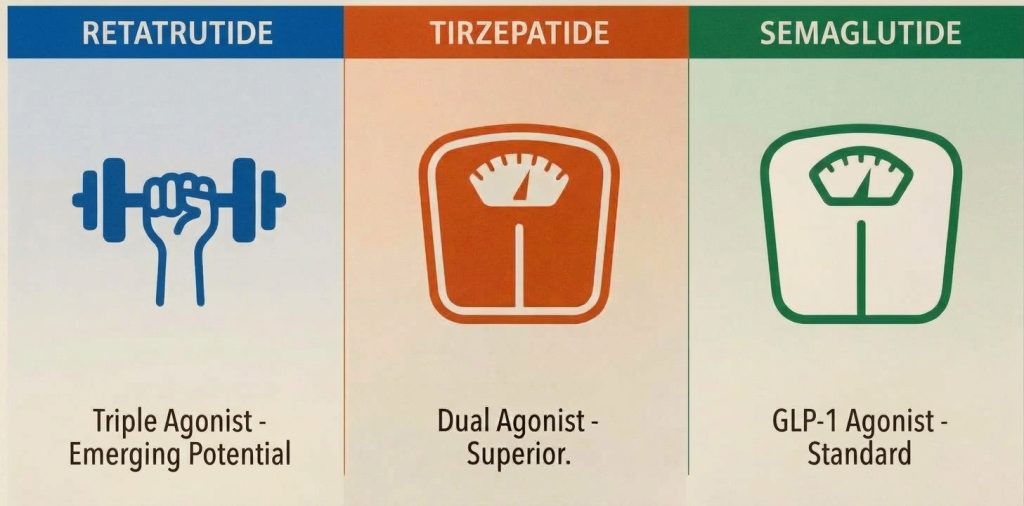
For a fuller comparison of the medicines and their mechanisms, read MedicalBluff’s retatrutide vs. semaglutide vs. tirzepatide guide.
The distinction matters because results from separate clinical trials cannot, by themselves, establish which medicine is best for an individual or how to transition safely between them.
Tirzepatide-to-Retatrutide Dosage Transition Chart: What Does the Evidence Support?
Online searches may return recommendations such as starting retatrutide at 1 mg, using 2 mg or less, or beginning seven days after the last tirzepatide injection. These are not established switching recommendations simply because they appear on websites.
The following chart distinguishes the available evidence from assumptions that should not be presented as validated clinical guidance.
| Switching question | Evidence-based interpretation |
|---|---|
| Is there a validated dose-conversion chart? | No established conversion chart for this switch has been identified in the evidence reviewed. |
| Can the previous tirzepatide dose determine the retatrutide starting dose? | No validated conversion rule establishes this. |
| Is starting retatrutide on day seven a proven universal protocol? | No validated retatrutide-specific evidence establishes day seven as a universal switching rule. |
| Is a zero-day washout proven safe? | No validated switching evidence establishes that approach. |
| Can retatrutide trial doses be used as a personal switching schedule? | No. Trial regimens are research protocols, not individual prescribing instructions. |
| What should happen before a treatment change? | A qualified healthcare professional should assess the clinical circumstances and appropriate treatment options. |
This is an evidence-status chart, not a dosing prescription. The absence of a validated protocol does not prove that a particular interval is necessarily unsafe or safe; it means that the available evidence does not establish a universal schedule.
Why Trial Doses Are Not Switching Doses
Clinical trials evaluate medicines under predefined conditions, including eligibility criteria, dose-escalation schedules, monitoring and safety reporting. Participants may have different treatment histories from people seeking to switch medicines in routine practice.
The Phase 3 TRIUMPH-1 study published in 2026 evaluated retatrutide in adults with obesity who did not have diabetes. Its treatment regimens and findings provide evidence about retatrutide in the studied population, but the trial does not establish a dose-conversion schedule for people switching from tirzepatide.
Consequently, a starting dose or dose-escalation schedule studied in a trial cannot automatically be used for someone who has recently received tirzepatide.
For additional context on the investigational drug’s clinical-trial dosing, see MedicalBluff’s retatrutide dosage and clinical-trial safety guide.
Retatrutide Washout Period: How Long Should You Wait?
There is no established, clinically validated washout interval specifically for switching from tirzepatide to retatrutide in the evidence reviewed for this article.
A washout period is the interval between stopping one medicine and starting another. Depending on the medicines involved, clinicians may consider residual drug activity, overlapping effects, potential interactions and individual safety factors when evaluating a treatment change.
However, calculating how long a medicine remains in the body does not, by itself, establish a safe or effective switching interval.
What Does Tirzepatide’s Half-Life Tell Us?
According to the current U.S. prescribing information for Zepbound, tirzepatide has an elimination half-life of approximately 5–6 days in patients with overweight or obesity and in patients with obesity and obstructive sleep apnea.
This means that tirzepatide concentrations decline gradually rather than disappearing immediately after an injection.
Its half-life alone does not determine when retatrutide could safely be started. A suitable transition would require appropriate clinical evidence and consideration of the individual’s treatment history and circumstances.
There is therefore no scientifically justified basis in the cited evidence for presenting a specific number of days as a universal retatrutide washout rule.
What Are the Potential Safety Concerns?
Switching between medicines that affect appetite and metabolic pathways requires attention to tolerability, existing health conditions and other medications.
1. Gastrointestinal Symptoms
Tirzepatide can cause nausea, vomiting, diarrhea, constipation and abdominal discomfort. Gastrointestinal adverse events have also been reported in retatrutide clinical trials.
Symptoms can affect hydration, food intake and treatment tolerability. It has not been established that a particular switching schedule eliminates these risks.
For more detail on the reported findings and limitations of retatrutide safety data, read our retatrutide side effects and clinical-trial safety guide.
2. Dehydration and Reduced Food Intake
Persistent vomiting or diarrhea can lead to dehydration. Tirzepatide prescribing information warns about volume depletion associated with gastrointestinal adverse reactions.
Reduced appetite may also make it more difficult to consume adequate fluids and nutrients. People experiencing persistent vomiting, diarrhea, dizziness or difficulty maintaining fluid intake should seek appropriate medical advice rather than attempting to manage a medicine transition independently.
3. Blood Glucose and Other Medications
Tirzepatide affects blood glucose regulation. The risk of hypoglycemia can increase when it is used with insulin or a sulfonylurea.
People with diabetes may need their treatment and blood glucose monitoring reviewed when medication changes are considered. They should not independently adjust insulin, sulfonylureas or other prescribed medicines to accommodate a proposed switch.
Because retatrutide remains investigational, its use cannot be assumed to have the same established prescribing guidance as an approved medicine.
4. Unapproved Retatrutide Products
Products sold online as research peptides or unapproved retatrutide injections may not have undergone the regulatory review required for approved medicines. Their identity, quality, purity, storage conditions and safety may be uncertain.
The U.S. Food and Drug Administration states that retatrutide cannot be used in compounding under U.S. federal law and that it has not been found safe and effective for any condition by the agency.
These are U.S. regulatory statements; requirements in other countries may differ. Nevertheless, products marketed online should not be treated as approved medicines simply because they claim to contain retatrutide.
Read the FDA’s information on unapproved GLP-1 drugs used for weight loss.
What Should You Discuss with Your Healthcare Professional?
Anyone considering a change in weight-management treatment should discuss the decision with a qualified healthcare professional. Relevant questions may include:
- Why is the current treatment being changed?
- What benefits and adverse effects have occurred with tirzepatide?
- Are approved treatment alternatives appropriate for the person’s medical history and treatment goals?
- Are diabetes medicines or other treatments likely to require review?
- What monitoring is appropriate for weight, hydration, nutrition and blood glucose, where relevant?
- Is participation in a properly supervised clinical trial an available option?
These questions support an informed treatment discussion without assuming that retatrutide is an approved or routinely available replacement for tirzepatide.
Frequently Asked Questions
Can I switch from tirzepatide to retatrutide? + There is no established, validated clinical protocol for routinely switching from tirzepatide to retatrutide in the evidence reviewed for this article. Retatrutide remains investigational and is not FDA-approved. Do not attempt this transition using online dosing advice or unapproved products.
How do you switch from tirzepatide to retatrutide dosage? + No validated dose-conversion chart establishes how a tirzepatide dose should translate into a retatrutide dose.
Do not use trial doses to plan your own treatment switch. Discuss treatment options with a qualified healthcare professional.
What is the washout period when switching from tirzepatide to retatrutide? + Current evidence does not establish a standard, clinically validated washout interval for this switch. Tirzepatide’s approximately 5–6-day half-life does not, on its own, determine an appropriate interval.
Is switching from tirzepatide to retatrutide on day seven evidence-based? + Do not describe a seven-day interval as a universal, validated protocol for switching to retatrutide. Claims about a specific interval require appropriate evidence and clinical context.
Is retatrutide stronger than tirzepatide? + The medicines have different receptor activity, and results from separate trials cannot reliably establish that one is universally stronger or better. Differences in study populations, dose regimens, study duration and outcomes matter. Retatrutide also remains investigational.
Can I use retatrutide while tirzepatide is still active in my body? + There is no validated routine protocol establishing that overlapping these treatments is safe. Do not combine or overlap them based on online advice. Discuss any proposed treatment change with a qualified healthcare professional.
There is no established, validated clinical protocol for routinely switching from tirzepatide to retatrutide in the evidence reviewed for this article. Retatrutide remains investigational and is not FDA-approved. Do not attempt this transition using online dosing advice or unapproved products.
No validated dose-conversion chart establishes how a tirzepatide dose should translate into a retatrutide dose.
Do not use trial doses to plan your own treatment switch. Discuss treatment options with a qualified healthcare professional.
Current evidence does not establish a standard, clinically validated washout interval for this switch. Tirzepatide’s approximately 5–6-day half-life does not, on its own, determine an appropriate interval.
Do not describe a seven-day interval as a universal, validated protocol for switching to retatrutide. Claims about a specific interval require appropriate evidence and clinical context.
The medicines have different receptor activity, and results from separate trials cannot reliably establish that one is universally stronger or better. Differences in study populations, dose regimens, study duration and outcomes matter. Retatrutide also remains investigational.
There is no validated routine protocol establishing that overlapping these treatments is safe. Do not combine or overlap them based on online advice. Discuss any proposed treatment change with a qualified healthcare professional.
Bottom Line
Interest in switching from tirzepatide to retatrutide has created demand for dosage charts and washout recommendations. However, the clinical evidence reviewed for this article does not establish a validated dose-conversion chart or standard washout period for this transition as of October 2026.
Tirzepatide’s half-life and retatrutide’s clinical-trial dosing schedules provide useful scientific context, but neither establishes a universal switching protocol. Retatrutide remains investigational, and unapproved products may carry additional quality and safety risks.
The appropriate next step is to discuss treatment options with a qualified healthcare professional and avoid self-directed switching based on unverified online recommendations.
Medical disclaimer: This article is for educational purposes only. It does not provide an individual dosing plan and is not a substitute for professional medical advice, diagnosis or treatment.
References
- ClinicalTrials.gov. A Study of Retatrutide (LY3437943) in Participants Who Have Obesity or Overweight (TRIUMPH-1). NCT05929066. https://clinicaltrials.gov/study/NCT05929066
- U.S. Food and Drug Administration. FDA’s Concerns with Unapproved GLP-1 Drugs Used for Weight Loss. https://www.fda.gov/drugs/drug-alerts-and-statements/fdas-concerns-unapproved-glp-1-drugs-used-weight-loss
- National Library of Medicine, DailyMed. Zepbound (tirzepatide) Injection: Prescribing Information. https://dailymed.nlm.nih.gov/dailymed/drugInfo.cfm?setid=487cd7e7-434c-4925-99fa-aa80b1cc776b
- Jastreboff AM, Kaplan LM, et al. Triple–Hormone-Receptor Agonist Retatrutide for Obesity — A Phase 2 Trial. The New England Journal of Medicine. 2023;389:514–526. https://doi.org/10.1056/NEJMoa2301972
- Jastreboff AM, Kaplan LM, Davies MJ, et al.; TRIUMPH-1 Investigators. Retatrutide, a Triple Hormone Receptor Agonist, for Treatment of Obesity. The New England Journal of Medicine. Published September 29, 2026. https://doi.org/10.1056/NEJMoa2604169