


Retatrutide vs. Tirzepatide vs. Semaglutide: Which Works Best for Weight Loss?
Retatrutide, tirzepatide and semaglutide are often discussed together when people look for effective weight-loss treatments. But there’s an important difference between them: they don’t act on exactly the same hormone receptors, and the results seen in clinical trials aren’t directly interchangeable.
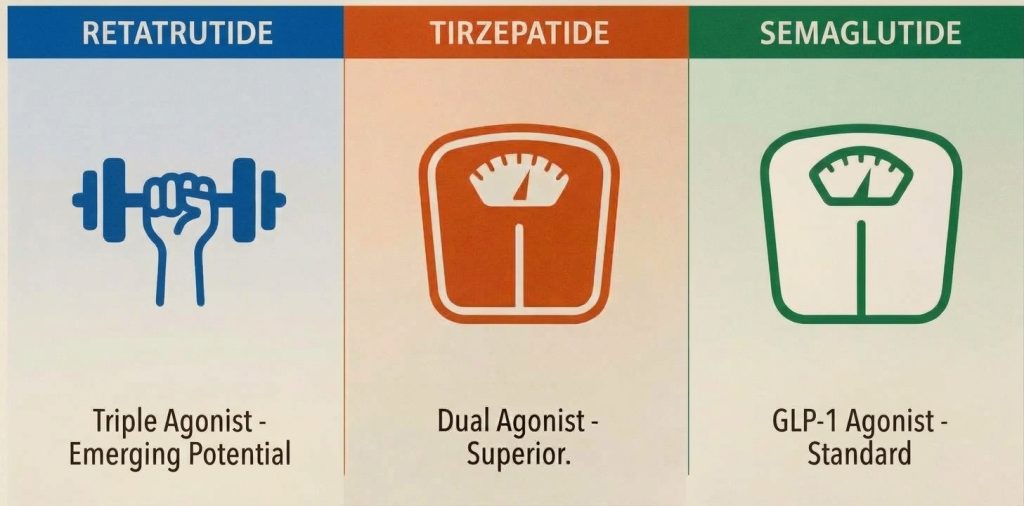
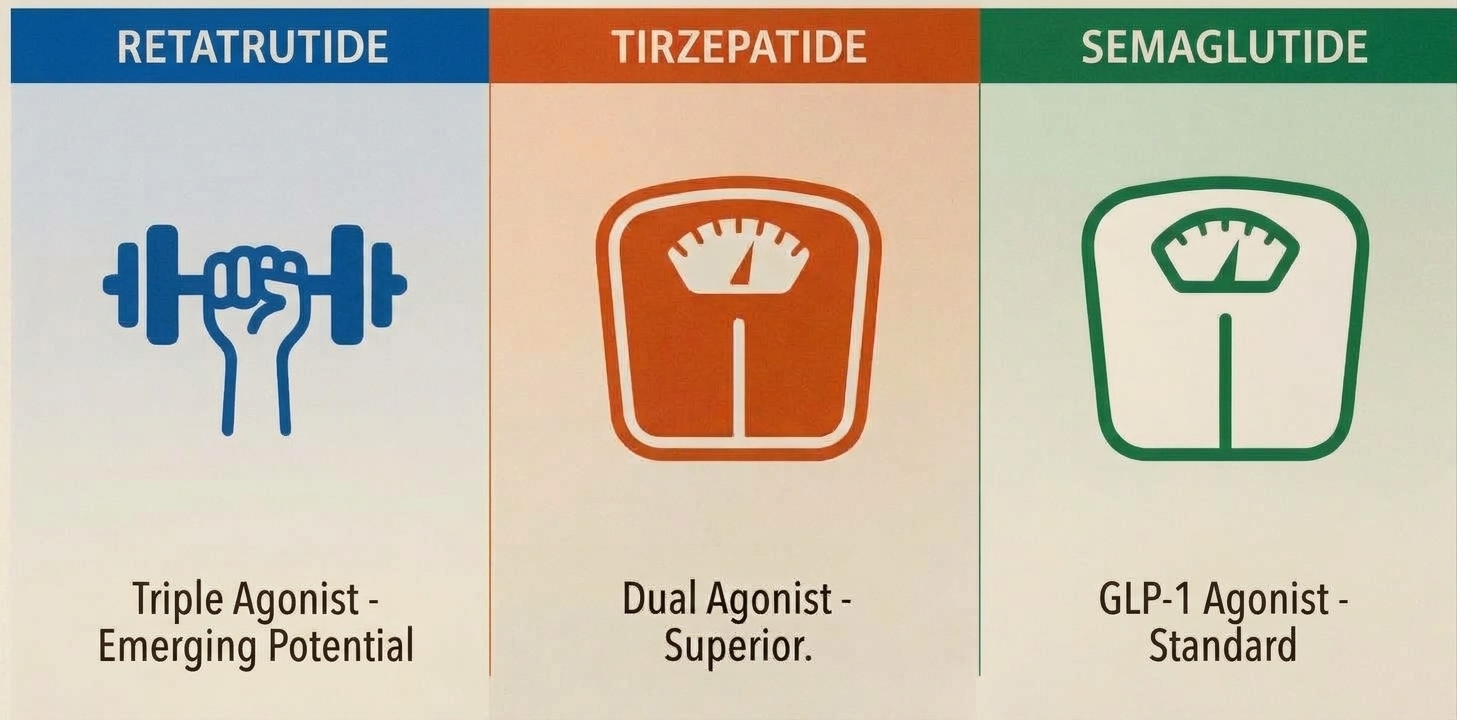
Semaglutide works on the GLP-1 receptor, while tirzepatide targets both GLP-1 and GIP receptors. Retatrutide goes one step further by targeting three receptors: GLP-1, GIP and glucagon. That triple action is one reason researchers are paying close attention to it. You can read more about its development in Eli Lilly’s official retatrutide update.
So, does targeting three receptors mean retatrutide works better? Not necessarily. Tirzepatide has been compared directly with semaglutide in the SURMOUNT-5 trial, while retatrutide has shown substantial weight loss in its own clinical trials. Until direct comparative evidence is available, it would be premature to declare one the clear winner.
One important point before we compare them: As of October 2026, retatrutide remains investigational and is not approved for routine public use. Its trial results are promising, but it isn’t yet an approved alternative to prescribed weight-loss medicines.
Quick Answer: Retatrutide vs. Tirzepatide vs. Semaglutide
Semaglutide targets one receptor, tirzepatide targets two, and retatrutide targets three. Tirzepatide has demonstrated greater average weight reduction than semaglutide in a direct clinical trial. Retatrutide has produced substantial weight-loss results in its own studies, but it has not been directly compared with both medicines in a completed head-to-head obesity trial.
The practical distinction is therefore not simply one, two or three receptors. It is the combination of clinical evidence, safety, regulatory approval, patient characteristics and the outcomes that matter to each individual.
Quick Comparison Table
| Feature | Semaglutide | Tirzepatide | Retatrutide |
|---|---|---|---|
| Receptor activity | GLP-1 | GIP + GLP-1 | GIP + GLP-1 + glucagon |
| Drug type | Single agonist | Dual agonist | Triple agonist |
| Example brand associated with weight management | Wegovy | Zepbound | No approved brand for routine use |
| Clinical development status | Approved for specified uses | Approved for specified uses | Investigational |
| Direct head-to-head obesity evidence | Compared directly with tirzepatide | Compared directly with semaglutide | No completed direct comparison with both |
| Main evidence limitation | Results depend on indication, dose and population | Results depend on indication, dose and population | Long-term evidence and regulatory review remain incomplete |
Sources: FDA prescribing information for Wegovy, SURMOUNT-5 trial in The New England Journal of Medicine, and Eli Lilly’s retatrutide information.
1. Semaglutide: The GLP-1 Receptor Approach
Semaglutide activates the GLP-1 receptor, a pathway involved in blood-glucose regulation, appetite and food intake. In the United States, Wegovy is an approved semaglutide brand used for specified weight-management indications. Ozempic also contains semaglutide but has different approved indications and dosing instructions.
The distinction between brand names matters. Readers should not assume that Ozempic and Wegovy are interchangeable for every indication simply because they contain the same active ingredient. Their approved uses, formulations and prescribed regimens need to be checked against the relevant product information.
In the STEP 1 trial, adults with overweight or obesity without diabetes received once-weekly semaglutide 2.4 mg or placebo alongside lifestyle intervention. At 68 weeks, the mean change in body weight was approximately −14.9% with semaglutide and −2.4% with placebo.
Reference: Wilding JPH, et al. Once-Weekly Semaglutide in Adults with Overweight or Obesity. The New England Journal of Medicine. 2021. Read the published study.
Those figures describe a particular trial population and treatment regimen. They are not a promise of the same result for every person, and they should not be compared with another trial’s result without considering differences in study design.
For a more detailed brand comparison, read MedicalBluff’s Ozempic vs. Wegovy vs. Zepbound: 2026 Clinical & Chemistry.
2. Tirzepatide: The Dual-Receptor Approach
Tirzepatide activates GIP and GLP-1 receptors. This dual activity distinguishes it from semaglutide, which activates the GLP-1 receptor.
In the United States, Zepbound is an approved brand of tirzepatide for specified weight-management indications. Tirzepatide is also marketed under another brand for different approved uses. Brand, indication and prescribed dose all matter when interpreting clinical evidence.
What did the direct comparison show?
The SURMOUNT-5 trial, published in The New England Journal of Medicine in 2025, directly compared tirzepatide with semaglutide in adults with obesity but without type 2 diabetes. Participants received their maximum tolerated study doses alongside the trial’s treatment conditions for 72 weeks.
The mean percentage change in body weight at week 72 was:
- Tirzepatide: −20.2%
- Semaglutide: −13.7%
The difference was statistically significant in favour of tirzepatide in this trial. Gastrointestinal adverse events were common in both groups and occurred mainly during dose escalation.
Primary reference: Aronne LJ, et al. Tirzepatide as Compared with Semaglutide for the Treatment of Obesity. The New England Journal of Medicine. 2025. Read the trial.
This is stronger comparative evidence than simply placing percentages from two unrelated studies side by side. However, the results apply to the trial’s participants, doses, duration and study design. They do not mean tirzepatide is necessarily the best treatment for every patient or every medical indication.
3. Retatrutide: The Triple-Agonist Approach
Retatrutide, also known as LY3437943, is an investigational medicine developed by Eli Lilly. Researchers call it a triple agonist because it activates GIP, GLP-1 and glucagon receptors.
The scientific interest lies in the combination of these pathways. GLP-1 and GIP signalling are involved in metabolic regulation, while glucagon receptor activity is associated with energy metabolism. Researchers are studying whether this combination can provide substantial weight reduction and improvements in obesity-related complications.
However, a third receptor target does not automatically prove greater clinical benefit or better safety. The final assessment depends on the results of controlled trials, adverse events, longer-term follow-up and regulatory review.
What have retatrutide trials shown?
In the Phase 2 obesity trial published in 2023, researchers studied retatrutide in adults with overweight or obesity over 48 weeks. The 12 mg target-dose group had a mean body-weight reduction of 24.2%, compared with 2.1% in the placebo group.
A later Phase 3 trial, TRIUMPH-1, studied adults with obesity without diabetes for 80 weeks. The published report described mean body-weight changes of −17.6%, −23.7% and −25.0% in the 4 mg, 9 mg and 12 mg groups, respectively, using the treatment-regimen estimand. The placebo group had a mean change of −3.9%.
Primary references:
- Jastreboff AM, et al. Triple–Hormone-Receptor Agonist Retatrutide for Obesity. The New England Journal of Medicine. 2023. Read the Phase 2 study.
- Jastreboff AM, et al. Retatrutide, a Triple Hormone Receptor Agonist, for Treatment of Obesity. The New England Journal of Medicine. Published September 29, 2026. Read the Phase 3 paper.
These results are promising, but the Phase 2 and Phase 3 figures come from different studies and analysis methods. They should not be combined into one continuous dose-response comparison or treated as proof that retatrutide is superior to tirzepatide or semaglutide.
Lilly has also reported results from other Phase 3 studies, including TRIUMPH-2 in adults with overweight or obesity and type 2 diabetes. The study population matters: people with type 2 diabetes may experience different average weight-loss outcomes from people without diabetes.
Source: Eli Lilly’s September 2026 TRIUMPH-2 announcement.
For more context on the research doses and the distinction between trial protocols and approved treatment, read MedicalBluff’s Retatrutide Dosage: Weekly Dosing, Safety & Clinical Guide.
4. Why Receptor Chemistry Matters
From a pharmaceutical and chemistry perspective, these medicines illustrate how researchers can design molecules to act on different biological targets. Yet the number of targets is only one part of the pharmacology.
A medicine’s clinical performance also depends on its interaction with each receptor, exposure over time, dose, tolerability, patient characteristics and the outcomes measured in trials. Laboratory findings and a plausible mechanism can support a research hypothesis, but clinical studies must establish whether the medicine delivers meaningful benefits and acceptable risks in people.
This is why the labels single agonist, dual agonist and triple agonist are useful descriptions, not a ranking system.
Does a triple agonist mean more weight loss?
Not necessarily. Retatrutide has shown large average weight reductions in its clinical trials. However, a fair comparison with approved medicines requires direct comparative evidence or a carefully designed analysis that accounts for differences among trials.
The 2026 systematic review and network meta-analysis published in The BMJ assessed evidence from hundreds of randomised trials. It found substantial weight-loss effects with several medicines, while noting that evidence for emerging agents such as retatrutide was of low or very low certainty in the analysis. That is a reminder that promising results and mature evidence are not the same thing.
Reference: BMJ systematic review and network meta-analysis of medicines for overweight and obesity.
5. Which Medicine Produces More Weight Loss?
The answer depends on whether the comparison comes from a direct trial or separate studies.
| Evidence | What it tells us | What it cannot establish |
|---|---|---|
| SURMOUNT-5: tirzepatide vs semaglutide | Tirzepatide produced greater mean weight reduction under the conditions of this direct trial | That tirzepatide is best for every patient or every indication |
| STEP 1: semaglutide vs placebo | Semaglutide produced substantial mean weight reduction in its trial population | A direct comparison with retatrutide |
| Retatrutide Phase 2 and Phase 3 studies | Retatrutide has produced substantial mean weight reduction compared with placebo in its own trials | That retatrutide is superior to tirzepatide or semaglutide in a head-to-head trial |
These studies differ in participant selection, diabetes status, duration, doses and statistical analysis. Their percentages are useful for understanding each trial, but they should not be presented as if all three medicines were tested against one another in the same experiment.
Bottom line on weight loss: Tirzepatide has direct comparative evidence against semaglutide. Retatrutide has encouraging trial results, but its place relative to the approved medicines requires careful interpretation of the evolving evidence.
6. Safety and Side Effects
Safety is as important as average weight reduction. A treatment that produces substantial weight loss still needs to be assessed for tolerability, serious adverse events, discontinuations and long-term outcomes.
Gastrointestinal symptoms, including nausea, diarrhoea, vomiting and constipation, have been reported in trials of these medicines. The frequency and severity vary by medicine, dose, study population and treatment schedule. It would be misleading to claim that all three have identical side-effect profiles.
The FDA-approved prescribing information for semaglutide and tirzepatide describes their specific warnings, precautions and contraindications. Patients should consult the current label for the product prescribed to them and discuss their medical history with a qualified healthcare professional.
Retatrutide’s safety profile is still being evaluated. Phase 3 trials provide more information than early studies, but they cannot resolve every question about uncommon adverse events or very long-term use.
Read MedicalBluff’s dedicated guide: Retatrutide Side Effects: Clinical Trial Safety Data (2026).
Why online retatrutide products are a concern
Retatrutide remains investigational and is not approved for routine public use as of October 2026. Lilly states that it is available through its clinical trials and warns about products sold outside authorised studies.
A label, stated milligram amount or seller-provided certificate does not independently establish a product’s identity, purity, potency or sterility. From a pharmaceutical quality perspective, these are separate attributes that require appropriate controls and evidence.
Readers should not use online retatrutide products or copy a clinical-trial dosing schedule for self-treatment.
7. Approval Status: An Important Difference
Regulatory status changes how these medicines can be used.
- Semaglutide: Certain semaglutide products, including Wegovy, are approved in the United States for specified indications. The exact approved use depends on the product and current prescribing information.
- Tirzepatide: Zepbound is approved in the United States for specified indications, including chronic weight management in eligible patients. Its approved uses and warnings should be checked against the current label.
- Retatrutide: Investigational and not approved for routine public use as of October 2026.
Approval does not mean that a medicine is suitable for everyone. Eligibility depends on the product’s approved indication, a person’s medical history, potential contraindications and professional assessment.
For current semaglutide information, consult the FDA Wegovy prescribing information. For retatrutide’s development status, consult Eli Lilly’s official update.
8. Could Retatrutide Replace Semaglutide or Tirzepatide?
It is too early to make that claim. Retatrutide’s clinical results make it an important investigational medicine, but approval and clinical positioning require a complete assessment of efficacy, safety, manufacturing quality and the regulatory evidence package.
Even if a future medicine achieves a larger average reduction in body weight, that alone would not establish that it is the right option for every patient. A clinician may also consider coexisting conditions, tolerability, contraindications, other treatments, availability and the patient’s goals.
Readers interested in the wider role of incretin medicines can continue with MedicalBluff’s article on GLP-1 Medications: Beyond Weight Loss — 2026’s Top Health Trend.
Frequently Asked Questions
Is retatrutide more effective than semaglutide? + Retatrutide has produced substantial average weight reduction in its own clinical trials. However, separate-trial percentages do not establish that it is more effective than semaglutide. A direct comparison or an appropriate evidence synthesis is needed to make a stronger comparative claim.
Is retatrutide better than tirzepatide? + There is not enough direct head-to-head evidence to conclude that retatrutide is better than tirzepatide. Retatrutide’s triple-receptor activity and promising trial results make it scientifically interesting, but they do not by themselves prove superiority.
What is the difference between retatrutide, tirzepatide and semaglutide? + Semaglutide activates GLP-1 receptors, tirzepatide activates GIP and GLP-1 receptors, and retatrutide activates GIP, GLP-1 and glucagon receptors. Their clinical evidence, approved status and safety information also differ.
Which has the strongest direct comparison evidence? + The SURMOUNT-5 trial directly compared tirzepatide with semaglutide in adults with obesity without type 2 diabetes. Tirzepatide produced greater mean weight reduction at 72 weeks under the trial conditions. That result should not be extrapolated automatically to retatrutide.
Is retatrutide FDA-approved? + No. As of October 2026, retatrutide remains investigational and is not approved for routine public use. Its availability will depend on the clinical development and regulatory review process.
Can I switch from semaglutide or tirzepatide to retatrutide? + Retatrutide is not an approved routine treatment, so readers should not attempt to switch to it or obtain it from unverified online sellers. Anyone considering a change in prescribed treatment should speak with their healthcare professional.
Retatrutide has produced substantial average weight reduction in its own clinical trials. However, separate-trial percentages do not establish that it is more effective than semaglutide. A direct comparison or an appropriate evidence synthesis is needed to make a stronger comparative claim.
There is not enough direct head-to-head evidence to conclude that retatrutide is better than tirzepatide. Retatrutide’s triple-receptor activity and promising trial results make it scientifically interesting, but they do not by themselves prove superiority.
Semaglutide activates GLP-1 receptors, tirzepatide activates GIP and GLP-1 receptors, and retatrutide activates GIP, GLP-1 and glucagon receptors. Their clinical evidence, approved status and safety information also differ.
The SURMOUNT-5 trial directly compared tirzepatide with semaglutide in adults with obesity without type 2 diabetes. Tirzepatide produced greater mean weight reduction at 72 weeks under the trial conditions. That result should not be extrapolated automatically to retatrutide.
No. As of October 2026, retatrutide remains investigational and is not approved for routine public use. Its availability will depend on the clinical development and regulatory review process.
Retatrutide is not an approved routine treatment, so readers should not attempt to switch to it or obtain it from unverified online sellers. Anyone considering a change in prescribed treatment should speak with their healthcare professional.
Bottom Line
Semaglutide, tirzepatide and retatrutide demonstrate how research into metabolic hormone pathways is evolving. Semaglutide activates one receptor, tirzepatide activates two, and retatrutide activates three. But receptor count alone does not tell us which medicine is best.
Tirzepatide has demonstrated greater average weight reduction than semaglutide in a direct clinical trial. Retatrutide has produced substantial weight-loss results in Phase 2 and Phase 3 studies, but it remains investigational and has not been established as superior to either approved medicine through a direct head-to-head comparison.
The most responsible conclusion is to follow the evidence rather than the hype. Approved medicines have defined indications and prescribing information; retatrutide’s full benefit-risk profile and regulatory status remain under evaluation.
Medical disclaimer: This article is for educational purposes only and does not replace professional medical advice. Do not start, stop or change a prescription medicine based on this article. Retatrutide remains investigational and should not be used outside authorised clinical-trial settings.
References
- Wilding JPH, et al. Once-Weekly Semaglutide in Adults with Overweight or Obesity. The New England Journal of Medicine. 2021. https://www.nejm.org/doi/full/10.1056/NEJMoa2032183
- Aronne LJ, et al. Tirzepatide as Compared with Semaglutide for the Treatment of Obesity. The New England Journal of Medicine. 2025. https://www.nejm.org/doi/10.1056/NEJMoa2416394
- Jastreboff AM, et al. Triple–Hormone-Receptor Agonist Retatrutide for Obesity. The New England Journal of Medicine. 2023. https://www.nejm.org/doi/full/10.1056/NEJMoa2301972
- Jastreboff AM, et al. Retatrutide, a Triple Hormone Receptor Agonist, for Treatment of Obesity. The New England Journal of Medicine. 2026. https://www.nejm.org/doi/abs/10.1056/NEJMoa2604169
- Eli Lilly and Company. What to Know About Retatrutide. Updated September 2026. https://www.lilly.com/news/stories/what-to-know-about-retatrutide
-
U.S. Food and Drug Administration. Wegovy Prescribing Information. https://www.accessdata.fda.gov/drugsatfda_docs/label/2025/215256s024lbl.pdf
-
Nong K, Shi Q, Xie X, et al. Comparative effects of drugs for adults with overweight or obesity: systematic review and network meta-analysis. The BMJ. 2026;394. https://doi.org/10.1136/bmj-2026-372161