


Liquid Collagen vs Powder: Which Is Better for Absorption, Dose & Value?
Liquid collagen is often marketed as easier to absorb than powder. The idea sounds convincing: a liquid is already dissolved, so perhaps the body can use it faster. But does that actually happen?
The important distinction is between collagen being hydrolyzed into smaller peptides and collagen being sold in liquid form. These are not the same thing. A powder can already contain hydrolyzed collagen peptides, and a ready-to-drink liquid does not automatically have a special absorption advantage.
For this comparison, we look beyond marketing claims. We examine human research, actual collagen quantities, ingredients, product-label information and the cost-per-gram calculation buyers can use before choosing a supplement.
Affiliate disclosure: This article contains affiliate links. MedicalBluff may earn a commission if a reader purchases through these links, at no additional cost to the buyer. Product selection and discussion are based on label information and available evidence, not independent laboratory testing.
1. Liquid Collagen vs Powder: What Is Actually Different?
The main difference is the delivery format, not necessarily the collagen itself.
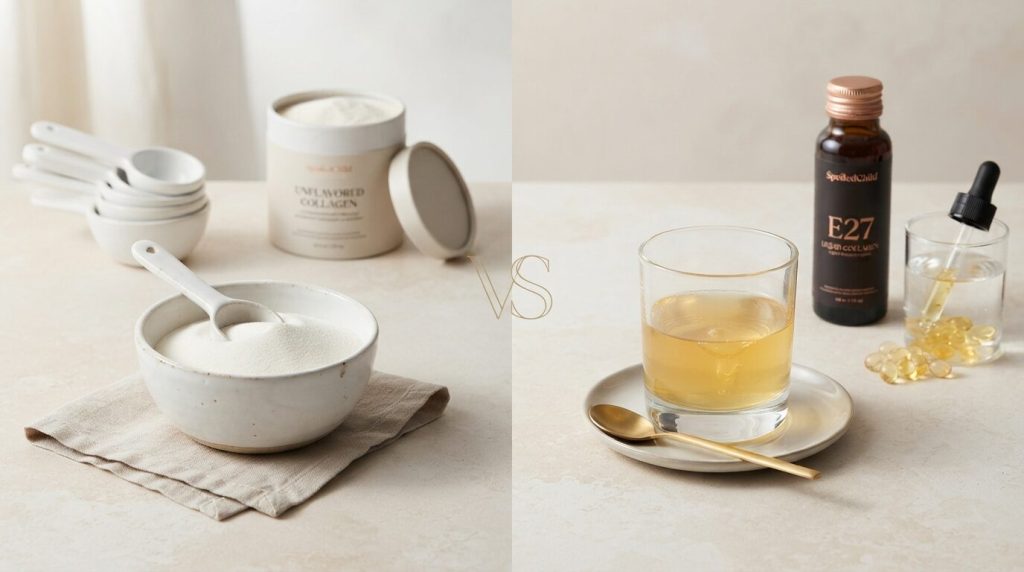
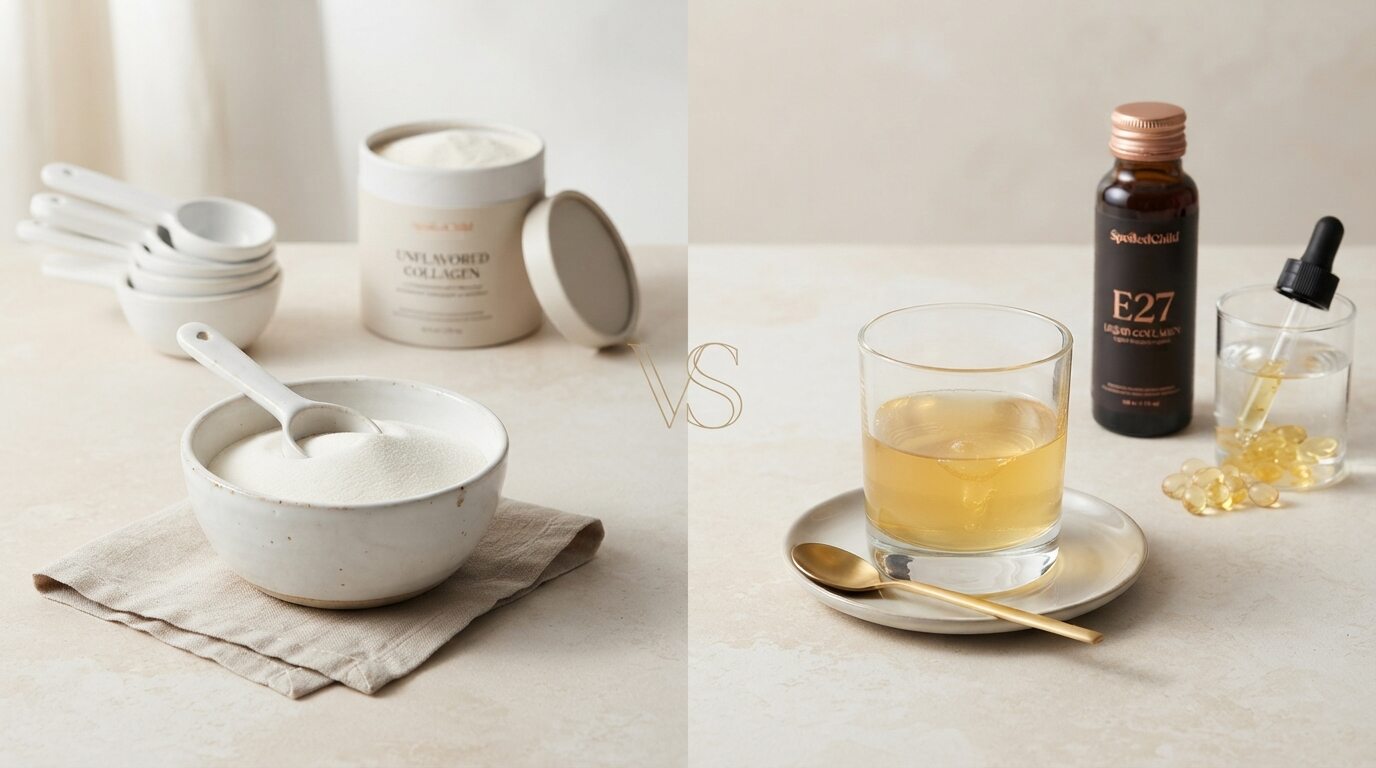
Liquid collagen
Liquid collagen supplements are ready-to-drink products or concentrated liquids. They may contain hydrolyzed collagen peptides alongside ingredients such as vitamin C, hyaluronic acid, flavourings, sweeteners and preservatives.
Potential advantages:
- No mixing or preparation.
- Convenient for people who dislike powders.
- Easy to carry and consume.
- Some formulations combine collagen with additional ingredients.
Potential disadvantages:
- A serving may contain less collagen than a typical powder serving.
- Some products contain added sweeteners, acids or preservatives.
- The amount of collagen per bottle can be difficult to judge without calculating the serving count.
- Storage instructions and shelf life deserve attention.
Collagen powder
Collagen powder usually contains hydrolyzed collagen peptides that can be mixed into water, coffee, smoothies or other suitable drinks.
Potential advantages:
- Often provides a larger collagen quantity per serving.
- Easier to adjust the amount consumed.
- Unflavoured options can be mixed into different foods and drinks.
- Large containers may offer a lower cost per gram.
Potential disadvantages:
- Requires mixing.
- Some powders do not dissolve or taste equally well.
- Larger containers may be less convenient to carry.
- Product quality and ingredient transparency still vary.
An important point: Once a hydrolyzed collagen powder is mixed into water, it becomes a liquid solution. That does not make it identical to a commercially manufactured liquid supplement, because the two formulations may differ in concentration, ingredients, processing and storage. However, it does show why the word “liquid” alone cannot establish better absorption.
2. Does Liquid Collagen Absorb Better Than Powder?
This is the central question, and the available research does not justify a simple marketing-style answer.
To understand the issue, three concepts need to be separated.
Hydrolysis: Collagen is processed into smaller peptides. Hydrolyzed collagen is commonly used in supplements because the protein has already been broken down into shorter peptide chains.
Dissolution: Powder can dissolve in water or another drink. Dissolving a product does not automatically change its peptide composition or prove that it will be absorbed faster.
Bioavailability: This describes how much of a substance or its relevant components become available in the body. Detecting collagen-derived peptides in blood is not the same as proving a particular supplement produces better skin, hair or joint outcomes.
What did the human absorption study find?
A 2024 randomized, double-blind crossover study by Virgilio and colleagues investigated the bioavailability of collagen hydrolysates from different sources, including fish, porcine and bovine collagen.
The researchers measured hydroxyproline and selected collagen-related peptides in the blood after intake. The study found that the tested hydrolysates produced measurable circulating metabolites.
However, there were only six healthy volunteers. More importantly, the study compared collagen hydrolysates with different sources and molecular weights. It was not a direct comparison of commercially prepared liquid collagen against an equivalent dose of powder.
The research therefore helps explain how collagen-derived peptides appear in circulation, but it does not prove that ready-to-drink collagen is better absorbed than powder.
Reference: Virgilio et al., 2024 — Frontiers in Nutrition
What does this mean for buyers?
We have not identified a published human head-to-head trial demonstrating that an equivalent dose of liquid collagen produces superior absorption compared with collagen powder.
That does not prove both formats have identical absorption. It means the claimed advantage has not been established by the direct comparative evidence needed to support it.
A buyer should therefore be cautious about claims such as:
- Liquid collagen is absorbed instantly.
- Powder collagen is poorly absorbed.
- Liquid collagen produces better results simply because it is already dissolved.
Without appropriate comparative research, these statements go beyond what the evidence can establish.
3. Does Collagen Supplementation Actually Improve Skin?
Absorption is only one part of the question. Even if collagen-derived peptides enter the bloodstream, that does not automatically establish a visible improvement in skin.
The clinical evidence on oral collagen is mixed.
The 2025 systematic review
A 2025 systematic review and meta-analysis by Myung and Park included 23 randomized controlled trials involving 1,474 participants.
The overall analysis found improvements in skin hydration, elasticity and wrinkles. However, the results were no longer statistically significant when the researchers examined studies without pharmaceutical-industry funding and studies rated as higher quality.
The authors concluded that the available clinical evidence did not support using collagen supplements to prevent or treat skin aging.
Reference: Myung and Park, 2025 — The American Journal of Medicine
The updated 2026 review
A newer systematic review and meta-analysis published in 2026 included 35 randomized controlled trials involving 2,534 participants.
Its primary analysis reported improvements in instrumental measurements of skin hydration, elasticity and skin-barrier function. However, sensitivity analyses raised concerns about the apparent effects on structural outcomes such as wrinkles, skin roughness and dermal density.
Reference: Oral Collagen Peptides and Skin Rejuvenation, 2026
How should readers interpret these findings?
These reviews do not establish that every collagen supplement works, and neither demonstrates that liquid collagen is better than powder.
They also highlight why the quality of individual trials, funding, product formulations and outcome measurements matter.
A useful distinction is that research on oral collagen supplements in general cannot be treated as clinical proof for a particular commercial product.
4. Collagen Dose: Compare Grams, Not Bottle Size
A large bottle does not necessarily contain more collagen than a smaller powder container. The actual collagen quantity per serving is what matters.
Consider the two products selected for this comparison.
Vital Proteins Unflavoured Collagen Peptides
View Vital Proteins Collagen Peptides on Amazon
The selected product is the 567 g unflavoured powder.
The product images for this listing show 10 g of hydrolyzed bovine collagen per serving. The product is described as a single-ingredient collagen powder. The exact serving count and serving weight should be checked on the current container label.
SpoiledChild Liquid Collagen — Mango
View SpoiledChild Mango Liquid Collagen on Amazon
The product label shown in the Amazon images lists the bottle size as 450 mL (15.2 fl oz).
The Supplement Facts image shows a serving size of 1 tablespoon (15 mL) and approximately 33 servings.
| Label information | Amount per 15 mL serving |
|---|---|
| Bovine collagen peptides | 5 g |
| Protein | 5 g |
| Vitamin C | 80 mg |
| Hyaluronic acid | 30 mg |
| Sodium | 60 mg |
Source: Supplement Facts panel shown in the Amazon product images.
Side-by-side comparison
| Comparison point | Vital Proteins | SpoiledChild |
|---|---|---|
| Format | Powder | Liquid |
| Selected pack | 567 g | Listing title: 400 mL; product image: 450 mL |
| Collagen per serving | 10 g | 5 g |
| Serving information | Check current container label | 15 mL; approximately 33 servings |
| Additional ingredients | Single-ingredient collagen powder, according to listing images | Vitamin C and hyaluronic acid |
| Preparation | Mix before use | Ready to consume |
| Main convenience | Flexible mixing | No preparation |
The listed serving amounts are not equivalent. One Vital Proteins serving supplies twice the collagen quantity of one 5 g SpoiledChild serving.
That is a dose comparison, not proof that one product is more effective or better absorbed.
For a fair comparison, buyers should check the actual label on the container rather than relying only on an online product title.
5. How Much Does Each 10 Grams of Collagen Cost?
Comparing the price of one bottle with the price of one powder container can be misleading. The pack sizes, serving amounts and total collagen quantities are different.
A more useful calculation is:
Cost per 10 g of collagen = Product price ÷ Total grams of collagen in the container × 10
First calculate the total collagen:
Total collagen = Collagen per serving × Number of servings
For example, if a powder provides 10 g of collagen per serving across 30 servings, the container supplies 300 g of collagen in total.
For a liquid product, the calculation requires the exact collagen amount per serving and the actual number of servings in the bottle.
What information should buyers collect?
| Information | Why it matters |
|---|---|
| Current product price | Prices change with promotions and sellers |
| Collagen per serving | Shows the actual dose |
| Servings per container | Helps calculate total collagen |
| Total collagen per container | Makes pack sizes comparable |
| Cost per 10 g | Gives a fairer value comparison |
We are not assigning a price winner here because Amazon prices vary and a verified current price for both selected listings was not available for this comparison.
A buyer can use the formula above with the current checkout price to calculate the real difference.
6. Ingredients: What Else Is in the Formula?
Collagen quantity is important, but it is not the only label detail worth checking.
Vitamin C
Vitamin C is involved in normal collagen formation in the body. Some collagen products add it to their formulations.
However, adding vitamin C does not prove that a particular supplement is absorbed better or produces better results than another collagen product.
Hyaluronic acid
Hyaluronic acid is commonly added to beauty supplements. Its presence may make a product more complex, but it does not establish that the collagen itself has superior bioavailability.
Sweeteners, flavourings and preservatives
Ready-to-drink products may require ingredients to maintain flavour, stability and product quality.
For people who experience digestive discomfort or have sensitivities, it is worth checking the full ingredient list rather than looking only at the collagen quantity.
Ingredient quantity matters
A label may list several additional ingredients without disclosing the amount of every component. Buyers should distinguish between an ingredient being present and the product providing a clinically meaningful dose.
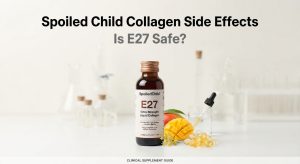
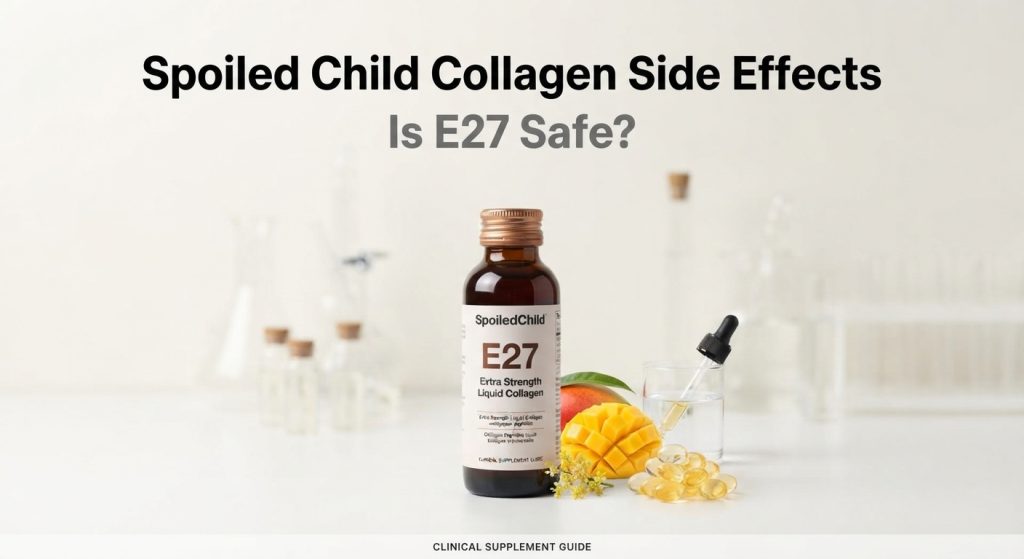
For a closer look at E27’s ingredients and reported tolerance concerns, read our SpoiledChild Collagen Side Effects: Is E27 Safe?.
7. Quality Control: What Should You Check Before Buying?
A supplement label is a starting point, not proof of the quality of every batch.
From a pharmaceutical quality-control perspective, several details deserve attention.
1. Ingredient identity
Does the product clearly identify its collagen source, such as bovine or marine collagen?
2. Declared quantity
Is the amount of actual collagen peptides stated per serving? A total blend weight should not automatically be interpreted as the collagen dose.
3. Manufacturing and quality information
Does the manufacturer explain its quality systems, manufacturing standards and product controls?
4. Testing transparency
Does the company provide meaningful information about testing for identity, purity and relevant contaminants?
5. Batch-specific documentation
A batch-specific Certificate of Analysis (COA), where available and appropriately verified, can provide more useful information than a broad marketing statement such as “third-party tested.”
A COA should be assessed for the product identity, batch number, test methods, results, acceptance criteria and issuing laboratory. A document that cannot be linked to the product’s actual batch offers limited reassurance.
6. Storage and expiry
Follow the manufacturer’s storage instructions. Liquid products may have specific refrigeration instructions after opening, while powders should be kept protected from moisture.
Neither format should be assumed to have better quality simply because it is liquid or powder.
8. Which Should You Choose: Liquid Collagen or Powder?
The practical choice depends on what matters most to the buyer.
Powder may be more suitable when:
- A larger collagen dose per serving is preferred.
- Mixing a supplement into a drink is not a problem.
- Unflavoured formulations are preferred.
- Cost per gram is an important consideration.
- Flexible serving amounts are useful.
Liquid may be more suitable when:
- Convenience is the main priority.
- Preparing a drink is inconvenient.
- A ready-to-consume format is easier to maintain.
- The buyer is comfortable with the product’s ingredients and serving amount.
Neither format is automatically superior. The choice should depend on the actual formula, dose, quality information, price and personal convenience.
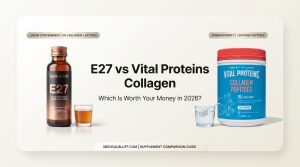
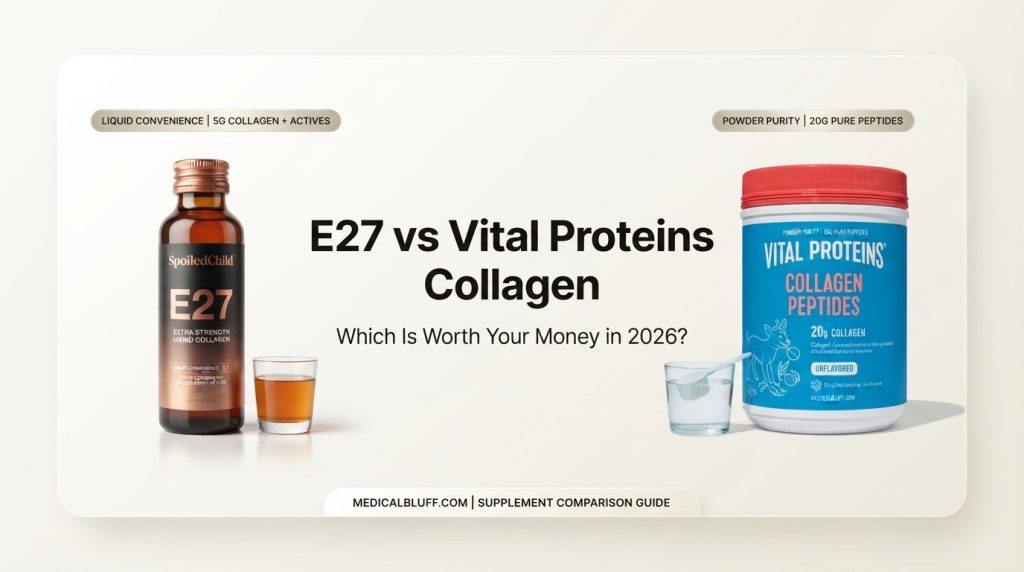
Readers comparing these two specific brands can also see our detailed SpoiledChild E27 vs Vital Proteins Collagen comparison.
For a closer look at the liquid product’s formulation and marketing claims, see our Spoiled Child Reviews: Does E27 Collagen Work?.
Frequently Asked Questions
Does liquid collagen absorb faster than powder? There is not enough direct human comparative evidence to establish that ready-to-drink liquid collagen absorbs faster than an equivalent dose of hydrolyzed collagen powder.
Is liquid collagen more effective than powder? Effectiveness cannot be determined by format alone. The collagen source, peptide characteristics, dose, formulation and quality of clinical evidence all matter. No established head-to-head evidence shows that liquid is generally more effective.
Is collagen powder already hydrolyzed? Many collagen peptide powders contain hydrolyzed collagen. Hydrolysis breaks collagen into smaller peptides before consumption. Check the product label to confirm the type of collagen supplied.
Can collagen powder be mixed with water? Yes. Many collagen peptide powders are designed to mix into water and other drinks. The resulting drink is a liquid solution, although it is not necessarily identical to a commercially formulated ready-to-drink collagen product.
Does a higher collagen dose guarantee better results? No. A higher dose does not automatically guarantee better skin, hair or joint outcomes. Clinical results depend on more than the amount listed on the label, and the evidence for different health outcomes remains mixed.
Is collagen with vitamin C better? Vitamin C contributes to normal collagen formation in the body. However, its presence in a supplement does not prove that the product has superior absorption or produces better clinical results.
How should I compare liquid and powder collagen prices? Calculate the total grams of collagen in each container, then divide the product price by the total collagen quantity and multiply by 10. This gives the cost per 10 g of collagen and makes different pack sizes easier to compare.
There is not enough direct human comparative evidence to establish that ready-to-drink liquid collagen absorbs faster than an equivalent dose of hydrolyzed collagen powder.
Effectiveness cannot be determined by format alone. The collagen source, peptide characteristics, dose, formulation and quality of clinical evidence all matter. No established head-to-head evidence shows that liquid is generally more effective.
Many collagen peptide powders contain hydrolyzed collagen. Hydrolysis breaks collagen into smaller peptides before consumption. Check the product label to confirm the type of collagen supplied.
Yes. Many collagen peptide powders are designed to mix into water and other drinks. The resulting drink is a liquid solution, although it is not necessarily identical to a commercially formulated ready-to-drink collagen product.
No. A higher dose does not automatically guarantee better skin, hair or joint outcomes. Clinical results depend on more than the amount listed on the label, and the evidence for different health outcomes remains mixed.
Vitamin C contributes to normal collagen formation in the body. However, its presence in a supplement does not prove that the product has superior absorption or produces better clinical results.
Calculate the total grams of collagen in each container, then divide the product price by the total collagen quantity and multiply by 10. This gives the cost per 10 g of collagen and makes different pack sizes easier to compare.
Bottom Line
Liquid collagen is convenient, but convenience should not be confused with superior absorption.
Hydrolyzed collagen powder can already provide peptides that are available for digestion and absorption. Current human research does not establish that an equivalent dose in a ready-to-drink liquid format is absorbed better.
The more meaningful comparison is the actual collagen quantity, formulation, ingredient transparency, testing information and cost per gram.
For buyers, the best decision is not necessarily the product with the most attractive packaging or the strongest absorption claim. It is the product whose label, quality information, dose and price make sense for their needs.
Evidence over hype: compare what is actually in the serving, not just the format on the front of the bottle.
References
- Virgilio N, et al. (2024). Absorption of bioactive peptides following collagen hydrolysate intake: a randomized, double-blind crossover study in healthy individuals. Frontiers in Nutrition. https://doi.org/10.3389/fnut.2024.1416643
- Myung SK, Park Y. (2025). Effects of Collagen Supplements on Skin Aging: A Systematic Review and Meta-Analysis of Randomized Controlled Trials. The American Journal of Medicine. https://doi.org/10.1016/j.amjmed.2025.04.034
- Oral Collagen Peptides and Skin Rejuvenation: A Systematic Review and an Updated Meta-Analysis of Randomized Controlled Trials. (2026). Journal of Cosmetic Dermatology. https://doi.org/10.1111/jocd.71041
- SpoiledChild. E27 Extra Strength Liquid Collagen product information. Official product information