


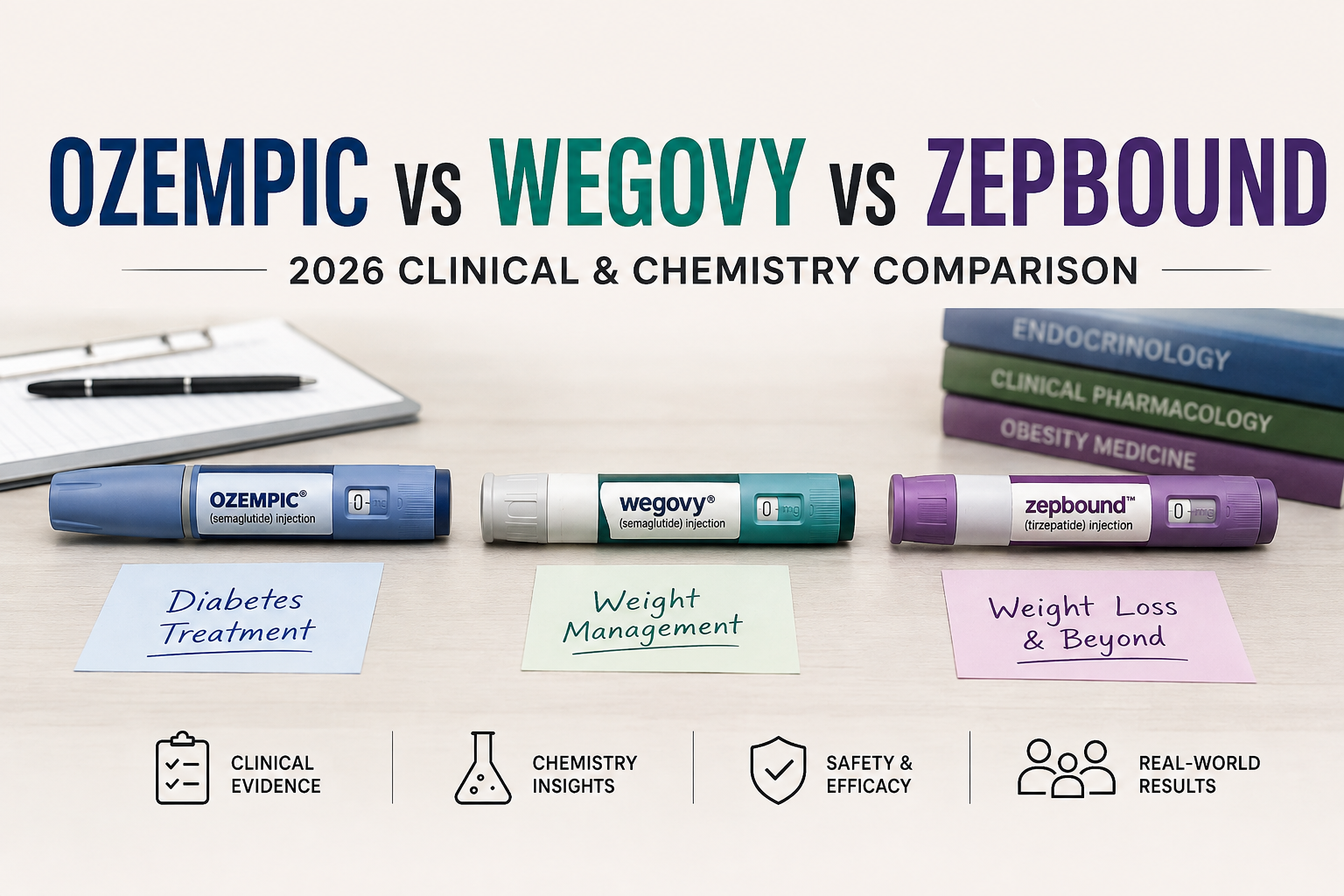
Ozempic vs Wegovy vs Zepbound: 2026 Clinical & Chemistry
If you’ve been searching for Ozempic, Wegovy, or Zepbound, you’ve probably seen these three names mentioned together. That’s understandable—they’re all part of the same GLP-1-based treatment conversation. But they aren’t the same medicine.
Ozempic and Wegovy contain semaglutide. Zepbound contains tirzepatide, a different molecule that acts on both GIP and GLP-1 receptors.
That difference starts with the chemistry and carries through to the way these drugs work, their approved uses, dosing, and the results seen in clinical trials. So comparing the three only by their brand names doesn’t tell us very much.
The comparison is also more interesting in 2026, with newer formulations and expanded clinical uses adding to an already fast-moving field. Current FDA information reflects these changes, so older articles can leave out important details.
With my MSc in Chemistry and more than 13 years of experience in the pharmaceutical industry, I want to look at these medicines from both angles: what their molecules do in the body and what clinical research has actually shown in patients.
That means going beyond the usual “Which one is best?” question and looking at semaglutide vs. tirzepatide, chemistry, approved uses, dosing, weight-loss results, and safety.
Affiliate Disclosure: Some links in this article are affiliate links. As an Amazon Associate I earn from qualifying purchases.
Quick Comparison: Ozempic vs Wegovy vs Zepbound
| Feature | Ozempic | Wegovy | Zepbound |
|---|---|---|---|
| Active ingredient | Semaglutide | Semaglutide | Tirzepatide |
| Molecular targets | GLP-1 receptor | GLP-1 receptor | GIP + GLP-1 receptors |
| FDA-approved uses | Type 2 diabetes; cardiovascular and kidney risk reduction in specific patients | Weight management; cardiovascular risk reduction in certain adults; MASH with moderate-to-advanced fibrosis | Chronic weight management; moderate-to-severe obstructive sleep apnea in adults with obesity |
| Same molecule as Ozempic? | — | Yes | No |
| Drug type | GLP-1 receptor agonist | GLP-1 receptor agonist | GIP/GLP-1 receptor agonist |
The simplest distinction is this: Ozempic and Wegovy use the same molecule, semaglutide. Zepbound uses tirzepatide, which targets two incretin pathways instead of one.
The table is only the quick view. The exact approved indications, formulations, and dosing are more detailed, and the 2026 FDA prescribing information is used for those sections rather than relying on older drug-comparison pages. FDA — Ozempic Prescribing Information FDA — Wegovy Prescribing Information FDA — Zepbound Prescribing Information
Semaglutide: The Molecule Behind Ozempic and Wegovy
Semaglutide is a GLP-1 receptor agonist and a modified analogue of human GLP-1. Its amino-acid sequence has approximately 94% homology with human GLP-1. FDA — Wegovy Prescribing Information
The interesting part from a pharmaceutical chemistry perspective is not simply that semaglutide resembles GLP-1. It is how specific chemical changes were made to the peptide.
Natural GLP-1 is broken down rapidly in the body, including by the enzyme DPP-4, which limits its useful duration. Semaglutide was designed with structural modifications that make it much more suitable as a long-acting medicine.
One of these changes replaces the alanine at position 8 with α-aminoisobutyric acid (Aib). This modification helps reduce susceptibility to DPP-4-mediated degradation. Another modification changes the amino acid at position 34 from lysine to arginine. The lysine at position 26 is then chemically modified with a C18 fatty diacid through a linker containing γ-glutamic acid and ethylene glycol units.
That fatty-acid side chain has an important job. It allows semaglutide to bind reversibly to human serum albumin in the bloodstream. Albumin is abundant in plasma, so this interaction helps slow the molecule’s clearance and contributes to its long duration of action.
In other words, semaglutide was not made long-acting by simply making the peptide larger. Its structure was deliberately modified at several positions to protect the peptide and change its pharmacokinetic behavior.
That is a good example of medicinal chemistry doing exactly what it is supposed to do: taking a naturally occurring biological signal and redesigning the molecule so that it can function as a practical medicine.
Tirzepatide: A Different Molecular Design
Zepbound contains tirzepatide, a different synthetic peptide with activity at both the GIP receptor and GLP-1 receptor. The molecule contains 39 amino acids and was designed with structural features that allow it to interact with both incretin systems.
Tirzepatide also carries a lipid modification, but its chemistry is not identical to semaglutide’s. A C20 fatty diacid is attached to lysine at position 20 through a linker containing γ-glutamic acid and two OEG units. This lipid modification promotes albumin binding and helps extend the peptide’s half-life.
There is another interesting structural detail. Tirzepatide contains α-aminoisobutyric acid (Aib) at position 2, which contributes to resistance against enzymatic degradation.
So tirzepatide is not simply a higher-dose or “stronger” version of semaglutide. The molecules are chemically different, their receptor targets are different, and their structures have been engineered in different ways to achieve prolonged activity.
The Molecular Difference at a Glance
| Medicine | Active molecule | Main receptor activity | Key structural feature |
|---|---|---|---|
| Ozempic | Semaglutide | GLP-1 receptor | C18 fatty diacid for albumin binding |
| Wegovy | Semaglutide | GLP-1 receptor | Same active molecule as Ozempic |
| Zepbound | Tirzepatide | GIP + GLP-1 receptors | C20 fatty diacid for albumin binding |
So the chemistry gives us a clean starting point:
Ozempic = semaglutide
Wegovy = semaglutide
Zepbound = tirzepatide
The difference is much deeper than the brand name. Semaglutide and tirzepatide are engineered peptide molecules with different structures, different receptor activity, and different pharmacokinetic designs.
Clinical trials then tell us something chemistry alone cannot: how those molecular differences translate into outcomes in actual patients.