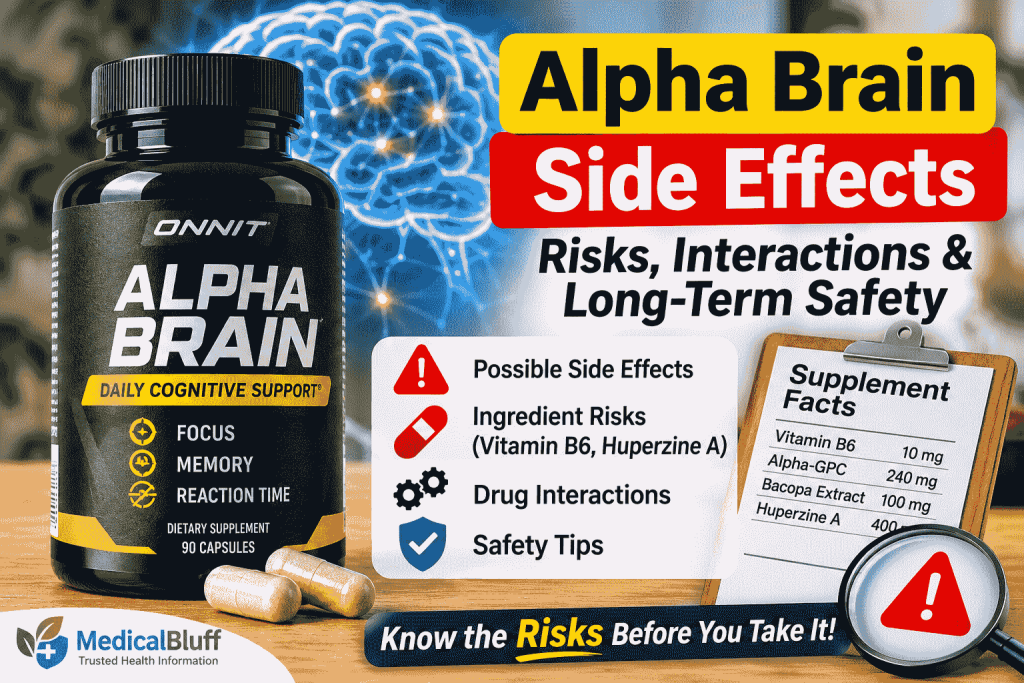



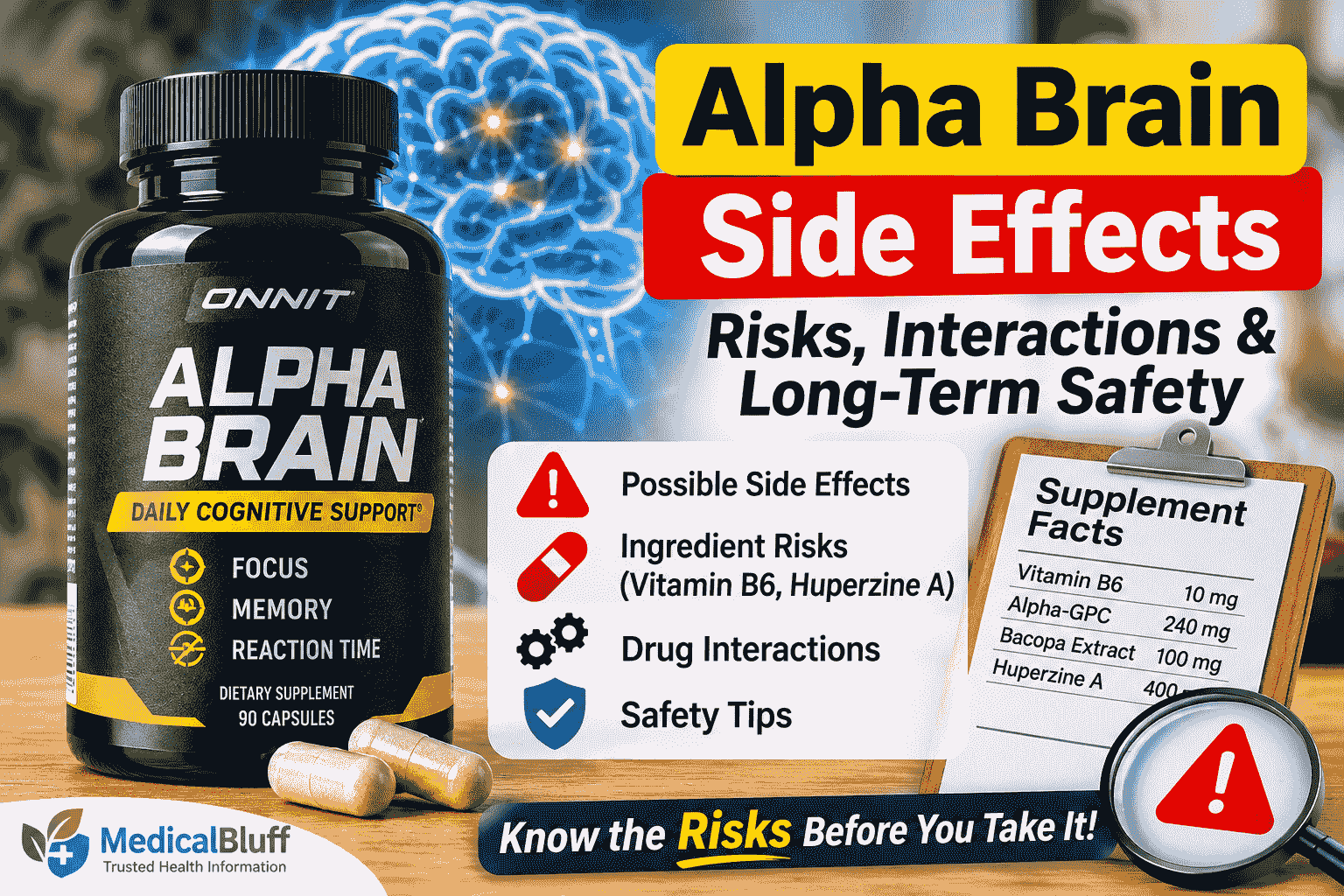
Alpha Brain Side Effects: Risks, Interactions & Long-Term Safety
Introduction
A supplement marketed for focus and memory can sound appealing, especially when its ingredient list includes compounds associated with cognitive function. But what happens when a product combines several active ingredients in one proprietary formula?
That is an important question with ONNIT Alpha Brain.
For a closer look at personal experience, ingredients and cognitive effects, read our 90-day Alpha Brain review
Alpha Brain contains ingredients such as Huperzia serrata extract, Alpha-GPC, Bacopa, L-theanine and vitamin B6. Some have been studied individually, but research on an individual ingredient does not establish the safety profile of the complete supplement.
The available human research on Alpha Brain is also limited. Short clinical trials cannot tell us everything about daily use over several months or years.
This guide examines the possible Alpha Brain side effects, what ingredient-level research actually shows, and who should discuss the supplement with a healthcare professional before taking it.
1. What Ingredients Are in Alpha Brain?
The 90-capsule formula listed by Onnit contains the following ingredients per two-capsule serving:
| Ingredient or blend | Amount per serving |
|---|---|
| Vitamin B6 | 10 mg |
| Flow Blend | 650 mg |
| Cat’s Claw extract | 350 mg |
| Focus Blend | 240 mg |
| Fuel Blend | 60 mg |
The blends contain:
- Flow Blend: L-Tyrosine, L-Theanine, Oat Straw Extract and Phosphatidylserine.
- Focus Blend: Alpha-GPC, Bacopa extract (100 mg) and Toothed Clubmoss extract.
- Fuel Blend: L-Leucine and Pterostilbene.
The Toothed Clubmoss extract is standardized to 1% Huperzine A, listed as 400 mcg.
These amounts refer to the listed two-capsule serving. Individual amounts for several ingredients remain undisclosed because they are grouped into proprietary blends.
Formula details can change, so readers should check the Supplement Facts panel on their own bottle.
2. Alpha Brain and Nausea or Stomach Problems
Digestive discomfort is one of the more relevant ingredient-level concerns.
Bacopa monnieri has been associated with gastrointestinal effects in clinical literature, including:
- Nausea
- Increased stool frequency
- Abdominal cramps
- Diarrhea
A clinical review published in StatPearls describes gastrointestinal symptoms as the most common adverse effects associated with Bacopa.
However, the Bacopa research does not establish how frequently these symptoms occur among Alpha Brain users. The amount of Bacopa in the listed formula is 100 mg per serving, and extracts can differ in composition and standardization.
Someone who develops persistent nausea, diarrhea or abdominal discomfort after starting a supplement should stop taking it and discuss the reaction with a healthcare professional.
3. Huperzine A: Dizziness, Nausea and Heart-Rate Concerns
Huperzine A deserves particular attention because it affects the breakdown of acetylcholine, a chemical messenger involved in memory, attention and other nervous-system functions.
Huperzine A has been investigated in clinical studies involving people with Alzheimer’s disease. A systematic review published in 2013 included 20 randomized trials involving 1,823 participants.
The review did not identify severe adverse events in the included trials. However, seven trials did not report safety information, and the authors cautioned that the evidence was not strong enough to establish long-term safety.
This matters because the studies involved Huperzine A as an individual treatment, not necessarily the complete Alpha Brain formula.
People should be especially cautious if they take medicines that affect acetylcholine activity or heart rate. A pharmacist or physician can assess whether combining these substances is appropriate.
4. Can Alpha Brain Cause Headaches, Insomnia or Vivid Dreams?
Some users discuss headaches, sleep disturbances and vivid dreams in online product reviews.
These reports can help identify questions worth investigating, but they cannot establish how frequently a reaction occurs or prove that Alpha Brain caused it.
The individual ingredients also have different research profiles. For example, L-theanine has been studied for its effects on relaxation and sleep, but that does not establish that the complete Alpha Brain formula causes or prevents insomnia.
The 2016 Alpha Brain clinical trial included sleep-related measures, but it was a six-week study and does not establish the long-term sleep effects of the supplement.
If sleep changes, persistent headaches or unusual neurological symptoms develop after starting Alpha Brain, stop using it and seek medical advice.
5. Vitamin B6: Can Long-Term Use Affect Nerves?
This is an important part of the formula that readers should not overlook.
The listed Alpha Brain serving provides 10 mg of vitamin B6 as pyridoxine hydrochloride.
Vitamin B6 is essential for normal nervous-system function. However, excessive intake from supplements over time can cause peripheral neuropathy, a condition involving damage to peripheral nerves.
Possible warning symptoms include:
- Tingling in the hands or feet
- Numbness
- Burning sensations
- Problems with balance or coordination
The NIH Office of Dietary Supplements lists the adult upper intake level in the United States as 100 mg per day from all sources. However, the European Food Safety Authority established a lower adult upper limit of 12 mg per day in 2023.
These limits differ because health authorities use different assessments of the available evidence.
A 10 mg serving does not mean that nerve damage will occur. However, someone taking a multivitamin, B-complex product or another supplement containing vitamin B6 should calculate their combined intake rather than considering Alpha Brain in isolation.
6. Alpha Brain and Blood Pressure: What Do We Know?
Some online customer reports describe blood-pressure changes after taking Alpha Brain.
An individual report cannot establish that the supplement caused the change. Blood pressure can fluctuate for many reasons, including stress, illness, medication changes and measurement conditions.
There is not enough reliable product-specific evidence to claim that Alpha Brain causes hypertension.
People with existing hypertension, cardiovascular disease, an irregular heartbeat or a history of fainting should discuss the formula with their healthcare professional before use.
A sudden severe headache, chest pain, fainting or difficulty breathing requires urgent medical assessment rather than an assumption that the reaction is harmless.
7. Alpha Brain Drug Interactions
A multi-ingredient supplement can create interaction concerns even when each ingredient appears familiar.
Huperzine A affects acetylcholine breakdown. This makes medication review particularly important for people using drugs that influence cholinergic activity.
The complete formula also contains botanical extracts and other active ingredients. Their potential interactions should not be overlooked simply because the product is sold as a dietary supplement.
Before using Alpha Brain, discuss it with a healthcare professional if you take:
- Prescription medicines for neurological conditions
- Medicines affecting heart rate
- Blood-pressure medication
- Medicines that affect blood clotting
- Other nootropic or cognitive-support supplements
This is not a complete list of possible interactions. The exact medication list, dose and medical history matter.
Onnit’s product warning also advises people with medical conditions or those taking medications to consult a physician before use.
8. Who Should Avoid Alpha Brain or Seek Medical Advice First?
The manufacturer advises against use by pregnant or breastfeeding women and adolescents under 18.
Medical advice is particularly important for people who:
- Have a neurological or cardiovascular condition
- Have a history of abnormal heart rhythms or fainting
- Take prescription medication
- Use several supplements containing vitamin B6
- Have experienced an adverse reaction to a nootropic supplement
- Are scheduled for surgery
A supplement should not replace prescribed treatment for memory problems, attention difficulties or any diagnosed medical condition.
9. What Should You Do If You Experience an Alpha Brain Side Effect?
If an unexpected symptom appears after starting Alpha Brain, do not assume that you need to continue taking it until your body adjusts.
A sensible approach is:
- Stop taking the supplement if you suspect an adverse reaction.
- Record when you took it, how much you took and when the symptoms began.
- Keep the bottle and Supplement Facts panel available.
- Tell your healthcare professional about other medicines and supplements you use.
- Seek urgent care for severe symptoms such as chest pain, fainting, breathing difficulty, facial or throat swelling, or severe neurological symptoms.
In the United States, consumers and healthcare professionals can report suspected supplement-related adverse events through the FDA Safety Reporting Portal.
A report does not prove that a product caused the reaction, but it can help regulators identify potential safety signals.
10. Is Alpha Brain Safe for Long-Term Daily Use?
This question deserves an honest answer: long-term safety has not been adequately established by the available Alpha Brain trials.
Two human studies are particularly relevant.
The 2016 randomized trial
A randomized, double-blind, placebo-controlled study included 63 adults who completed six weeks of supplementation. The researchers investigated cognitive performance and sleep-related measures.
The study reported improvements in certain cognitive measures, including delayed verbal recall. However, its short duration and limited sample cannot establish safety over 90 days, one year or longer.
The 2018 military study
A second randomized, placebo-controlled study involved 43 active-duty soldiers over 31 days. Participants received Alpha Brain or placebo.
The researchers reported no adverse events among participants. However, the study was small, lasted only one month and used a three-capsule daily regimen.
Neither study provides enough evidence to guarantee long-term safety for every user.
People considering extended daily use should review their medication list, total vitamin B6 intake and individual health circumstances with a qualified professional.
Frequently Asked Questions
Does Alpha Brain cause nausea? Nausea is a possible ingredient-related concern. Bacopa has been associated with gastrointestinal effects in clinical literature, but the frequency of nausea specifically caused by Alpha Brain has not been established.
Can Alpha Brain cause dizziness? Dizziness is a possible concern when considering Huperzine A research. However, this does not establish that Alpha Brain causes dizziness in a particular percentage of users.
Does Alpha Brain cause high blood pressure? There is insufficient product-specific clinical evidence to conclude that Alpha Brain causes high blood pressure. Individual customer reports cannot establish causation.
Can Alpha Brain affect sleep? Sleep-related experiences may vary. Some consumers report changes in sleep or vivid dreams, but these reports do not establish a confirmed product-specific adverse effect.
Is Alpha Brain safe to take every day? Onnit provides daily-use directions, but available clinical trials are relatively short. Long-term safety has not been established.
Can Alpha Brain interact with prescription medication? Yes, interactions are possible with multi-ingredient supplements. Huperzine A’s effects on acetylcholine are particularly relevant when reviewing medicines that affect cholinergic activity. Ask a pharmacist or physician to review your complete medication and supplement list.
Does Alpha Brain contain caffeine? The standard Alpha Brain capsule formula is marketed as caffeine-free by Onnit. Check the exact product label because other products in the Alpha Brain range may have different formulations.
Nausea is a possible ingredient-related concern. Bacopa has been associated with gastrointestinal effects in clinical literature, but the frequency of nausea specifically caused by Alpha Brain has not been established.
Dizziness is a possible concern when considering Huperzine A research. However, this does not establish that Alpha Brain causes dizziness in a particular percentage of users.
There is insufficient product-specific clinical evidence to conclude that Alpha Brain causes high blood pressure. Individual customer reports cannot establish causation.
Sleep-related experiences may vary. Some consumers report changes in sleep or vivid dreams, but these reports do not establish a confirmed product-specific adverse effect.
Onnit provides daily-use directions, but available clinical trials are relatively short. Long-term safety has not been established.
Yes, interactions are possible with multi-ingredient supplements. Huperzine A’s effects on acetylcholine are particularly relevant when reviewing medicines that affect cholinergic activity. Ask a pharmacist or physician to review your complete medication and supplement list.
The standard Alpha Brain capsule formula is marketed as caffeine-free by Onnit. Check the exact product label because other products in the Alpha Brain range may have different formulations.
Bottom Line
Alpha Brain combines several ingredients that have been studied individually, but the complete formula has limited long-term human safety data.
For a broader perspective on how nutrition and supplements fit into health decisions, explore our guide to Food as Medicine
Bacopa’s gastrointestinal effects, Huperzine A’s cholinergic activity and vitamin B6’s potential for nerve toxicity at excessive long-term intake deserve attention.
That does not mean Alpha Brain is inherently dangerous, nor does it mean every reported symptom is caused by the supplement. It means consumers should understand the formula, check other sources of vitamin B6 and consider possible medication interactions before starting it.
A product marketed for mental performance should be judged by its evidence and safety information—not just its popularity or customer testimonials.
Evidence over hype.
References
- Solomon TM, et al. A randomized, double-blind, placebo controlled, parallel group, efficacy study of alpha BRAIN® administered orally. Human Psychopharmacology. 2016. PubMed
- Barringer ND, Crombie A, Kotwal R. Impact of a purported nootropic supplementation on measures of mood, stress, and marksmanship performance in U.S. active duty soldiers. Journal of the International Society of Sports Nutrition. 2018. Full text
- Yang G, et al. Huperzine A for Alzheimer’s Disease: A Systematic Review and Meta-Analysis of Randomized Clinical Trials. Full text
- NIH Office of Dietary Supplements. Vitamin B6 Fact Sheet for Consumers. Read the fact sheet
- Walker EA, Pellegrini MV. Bacopa monnieri. StatPearls. NCBI Bookshelf
- U.S. Food and Drug Administration. FDA 101: Dietary Supplements. FDA
- Onnit. Alpha BRAIN® Product Information and Supplement Facts. Official product page