



Best Liquid Collagen for Women Over 40: What the Evidence Actually Shows
Introduction
A woman comparing liquid collagen supplements may find one bottle promising 2,500 mg per serving and another advertising 12,500 mg. At first, the higher number looks like the obvious choice. But is it really?
Not necessarily.
Collagen supplements are not as straightforward as their front labels suggest. One formula may contain a specific collagen peptide studied in clinical trials, while another may provide a larger amount of collagen alongside biotin, vitamins, sweeteners, and other ingredients. The difference matters—especially when products cost $20, $50, or even close to $100.
For women over 40, the decision often comes down to a more practical question: Is there enough reliable evidence to justify paying for a particular liquid collagen formula?
Research has reported possible improvements in skin hydration and elasticity, but the findings are not consistent. Some analyses report benefits, while others find that results become less convincing when researchers examine study quality and industry funding.
That is why this comparison looks beyond marketing claims. We examine five liquid collagen products available to US consumers, compare their actual collagen content and ingredients, calculate their approximate cost, and separate clinical findings from claims that have not been adequately demonstrated.
The goal is not to find the bottle with the biggest number. It is to help readers understand what they are paying for—and whether the evidence supports it.
Affiliate disclosure: MedicalBluff may earn a commission from qualifying purchases made through links in this article, at no additional cost to readers. Our editorial assessments remain based on product information and available evidence.
Quick Answer: Which Liquid Collagen Is Worth Considering?
There is no single liquid collagen supplement proven to be the best for every woman over 40. These five products have different features worth comparing.
| Product | Main reason to consider it | Important limitation |
|---|---|---|
| NatureWise Liquid Collagen | 4,000 mg collagen per tube | Contains 2,000 mcg biotin |
| Zena Nutrition Liquid Collagen + Biotin | Uses 2,500 mg VERISOL® | Verify exact pack size and serving count |
| Youtheory Collagen Liquid | 5,000 mg total collagen, including VERISOL® | Whole formula has not been proven superior |
| Momentous Collagen Shot | 10 g collagen and NSF Certified for Sport distinction | Higher cost per serving |
| Swedish Collagen Deluxe Shots | 12,500 mg marine collagen per shot | Fish allergen and multiple additional ingredients |
The practical takeaway: NatureWise offers a convenient daily serving, Zena and Youtheory include the branded peptide ingredient VERISOL®, Momentous has a recognized sport-supplement certification, and Swedish Collagen provides a marine-source option. None should be selected simply because its label displays the largest collagen number.
1. Does Liquid Collagen Actually Work for Women Over 40?
Collagen is a structural protein found throughout the body. In skin, it contributes to the framework that helps maintain firmness and structure. Age-related changes, cumulative sun exposure, hormonal shifts, and other factors can influence the appearance and condition of skin.
Hydrolyzed collagen supplements contain collagen that has been broken down into smaller peptides. After ingestion, the body digests and absorbs these peptides and their constituent amino acids. That does not mean the supplement travels directly to facial skin or replaces collagen lost through aging.
Researchers have investigated whether oral collagen peptides can influence measurable skin characteristics.
What positive studies have found
A 2023 systematic review and meta-analysis examined 26 randomized controlled trials involving 1,721 participants. It reported improvements in skin hydration and elasticity among people taking collagen supplements.
A 2025 systematic review included 10 randomized controlled trials involving 646 participants. The most common daily dose was approximately 4 g, while the median dose was 3.5 g. The researchers reported improvements in hydration and elasticity but also identified limitations involving study quality and possible publication bias.
A 2026 meta-analysis examined 35 randomized controlled trials involving 2,534 participants. It reported improvements in instrumental measurements of skin hydration, elasticity, and skin-barrier function. However, findings involving wrinkles, skin roughness, and dermal density were less consistent.
These findings suggest a possible benefit for some measurable skin characteristics. They do not establish that every collagen supplement produces visible improvements.
For a real-world example of how a branded liquid collagen formula is marketed and evaluated, see our Spoiled Child Reviews: Does E27 Collagen Work?.
Why the evidence is still controversial
A particularly important 2025 meta-analysis, published in The American Journal of Medicine, evaluated 23 randomized controlled trials involving 1,474 participants.
The overall analysis reported positive results. However, when researchers examined funding sources and study quality, they found no significant benefits in studies that did not receive pharmaceutical-industry funding. High-quality studies also did not show significant improvements across the measured skin outcomes.
The authors concluded that current clinical evidence did not support collagen supplements for preventing or treating skin aging.
A September 2026 methodological critique raised further concerns about how previous collagen meta-analyses combined and analyzed different skin measurements. Its reanalysis did not find convincing evidence of benefit.
This disagreement matters. A statistically significant change in a laboratory measurement does not automatically mean a person will notice a meaningful improvement in the mirror.
What should women take away?
Oral collagen may have potential for skin hydration and elasticity, but the evidence remains uncertain. Claims that a supplement removes wrinkles, reverses aging, or restores youthful skin go beyond what the research can reliably establish.
2. How Much Collagen Should Women Over 40 Take?
There is no universally established recommended daily collagen dose specifically for women over 40.
Clinical trials have investigated different amounts, collagen sources, and peptide formulations. Some studies used 2.5 g daily, while others used 5 g or 10 g. A 2025 systematic review reported that doses in its included trials ranged from 1–10 g daily.
A few examples help explain why the number on the label should not be the only selection criterion.
The 2.5 g VERISOL® research
A randomized controlled study published in 2014 involved 114 women aged 45–65. Participants received 2.5 g of specific bioactive collagen peptides daily for eight weeks. The researchers reported a reduction in eye-wrinkle volume and changes in certain skin-related biomarkers.
This is relevant to women over 40 because the study population included middle-aged and older women.
However, the study examined a specific collagen ingredient. It does not prove that every product containing 2.5 g of collagen will produce the same results.
The 2.5 g versus 5 g study
Another study involving 69 women aged 35–55 investigated two daily amounts of specific collagen peptides: 2.5 g and 5 g.
Both collagen groups showed improvements in skin elasticity compared with placebo after eight weeks. The results did not establish that the higher dose was necessarily superior.
What about 10 g daily?
Some trials have investigated 10 g of collagen peptides daily. Higher amounts may be appropriate within particular research protocols, but more collagen does not automatically mean better skin results.
A product providing 12.5 g per serving should not automatically outrank a product providing 2.5–5 g.
A sensible approach: Compare the actual collagen ingredient and formulation, review the available research, and consider the serving size and price. Do not treat a study dose as a personalized medical recommendation.
3. Five Liquid Collagen Products Compared
The following comparison focuses on label information, ingredient differences, product format, and quality-verification details.
Prices are US-market snapshots from November 2026, not guaranteed current checkout prices. Retailer promotions, subscriptions, shipping, and pack sizes can change the final cost.
1. NatureWise Liquid Collagen — Check Price
Collagen amount: 4,000 mg per tube
Collagen type: Type I and III
Format: Single-serving liquid tubes
Example listing: NatureWise official product information
NatureWise provides 4,000 mg of hydrolyzed Type I and III collagen peptides in each serving. Its formula also includes vitamin C, B vitamins, hyaluronic acid, horsetail extract, and 2,000 mcg of biotin.
The mixed berry 30-tube Amazon listing had a price snapshot of approximately $19.19 in November 2026. That works out to approximately $0.64 per serving.
What makes it interesting
- Convenient single-serving tubes.
- 4 g of collagen peptides per serving.
- Includes vitamin C and other added ingredients.
- A relatively accessible entry point for someone comparing liquid products.
What deserves attention
The formula contains 2,000 mcg of biotin. That is substantially more than the adult adequate intake of 30 mcg per day.
High-dose biotin can interfere with certain laboratory tests, including some thyroid tests and cardiac troponin assays. Anyone using a biotin-containing supplement should tell their healthcare professional and laboratory before blood testing.
NatureWise also makes a third-party-testing claim. However, a general testing statement is not the same as a publicly accessible, batch-specific certificate of analysis.
Best reason to consider it: Convenience and a moderate collagen serving, provided the additional ingredients fit the buyer’s needs.
2. Zena Nutrition Liquid Collagen + Biotin — Check Price
Collagen amount: 2,500 mg VERISOL® per serving
Collagen source: Bovine-derived collagen peptides
Additional ingredient: 5,000 mcg biotin
Format: Liquid bottle
Zena combines 2,500 mg of VERISOL® bioactive collagen peptides with 5,000 mcg of biotin. The product is marketed as a zero-sugar liquid collagen formula and uses sweeteners including stevia and monk fruit.
The main reason to consider Zena is its use of VERISOL®, a branded collagen-peptide ingredient that has been investigated in clinical research.
A study of VERISOL® used 2.5 g daily in women aged 45–65. However, that research evaluated the specific ingredient, not the complete Zena formula. It would be misleading to describe the whole retail product as clinically proven.
What makes it interesting
- Clearly identifies a branded collagen ingredient.
- Provides 2.5 g of VERISOL® per serving.
- Liquid format.
- Zero-sugar positioning.
What deserves attention
The formula contains 5,000 mcg of biotin. This is a high amount and makes the laboratory-testing warning particularly important.
There is also a pack-size issue worth checking. The official product page and retailer listings have shown different bottle sizes and serving counts. A listing price is meaningless unless the exact bottle size and serving count match.
Best reason to consider it: Buyers specifically interested in a liquid formula containing VERISOL®, provided they verify the exact pack and consider the high biotin content.
Official product information: Zena Liquid Collagen + Biotin
3. Youtheory Collagen Liquid — Check Price
Collagen amount: 5,000 mg per packet
VERISOL® content: 2,500 mg
Format: 30 mL liquid packets
Flavor: Berry
Youtheory combines 2,500 mg of VERISOL® with an additional 2,500 mg of hydrolyzed collagen peptides, providing 5,000 mg total collagen per packet.
The product is sold in single-serving packets, which may appeal to people who prefer not to measure liquid from a bottle.
What makes it interesting
- 5 g total collagen per serving.
- Includes 2.5 g of VERISOL®.
- Convenient pre-measured packets.
- Berry flavor and ready-to-drink format.
What deserves attention
The presence of two collagen ingredients does not establish that the combination produces better results than either ingredient alone.
The US product page has offered different pack sizes and promotional prices. A 12-pack price should not be compared with the cost of a 30-pack or another retailer’s larger bundle.
The US label should also be checked directly for the exact product’s ingredient source and allergen information. Do not assume the source from a label sold in another country.
Best reason to consider it: A convenient option for someone who wants a pre-measured liquid serving with a specified amount of VERISOL®.
4. Momentous Collagen Shot — Check Price
Collagen amount: 10,000 mg per serving
Collagen source: Bovine
Format: 25 g single-serving packets
Additional ingredient: Vitamin C
Momentous provides 10 g of hydrolyzed bovine collagen per serving, together with 35 mg of vitamin C.
Its main distinction is not simply the collagen quantity. The specific Momentous Collagen Shot product has an NSF Certified for Sport listing. This certification is a useful quality-verification distinction for consumers concerned about product contents and prohibited substances.
However, certification does not establish that the product improves wrinkles, hydration, or skin elasticity.
The Sour Watermelon version contains approximately 3 g of added sugar per serving, so consumers who monitor added sugar should check the flavor-specific label.
What makes it interesting
- 10 g of collagen per serving.
- Single-serving format.
- Vitamin C included.
- NSF Certified for Sport product listing.
What deserves attention
The one-time price snapshot was approximately $44.99 for 15 servings, or about $3.00 per serving. Subscription pricing may differ.
That makes it more expensive per serving than several other options in this comparison. The higher collagen amount is not proof of better skin results.
Best reason to consider it: Consumers who place a high value on a recognized sport-supplement certification and prefer a clearly measured 10 g serving.
Official product page: Momentous Collagen Shot
5. Swedish Collagen Deluxe Shots — Check Price
Collagen amount: 12,500 mg per shot
Collagen source: Marine, fish-derived
Format: 25 mL liquid shots
Additional ingredients: Hyaluronic acid, vitamin C, biotin, vitamins, minerals, and other ingredients
Swedish Collagen Deluxe is a high-collagen marine formula. Its 25 mL shot provides 12,500 mg of hydrolyzed fish collagen, along with ingredients such as hyaluronic acid, vitamin C, biotin, zinc, and other nutrients.
The manufacturer reports a user trial involving 106 women over eight weeks. It states that 99% reported improved skin appearance and 95% noticed a reduction in the appearance of fine lines and wrinkles.
These are manufacturer-reported user-trial results. They should not be interpreted as findings from a randomized, placebo-controlled clinical trial.
What makes it interesting
- Marine collagen source.
- 12.5 g collagen per shot.
- Includes several additional ingredients.
- Convenient single-serving format.
What deserves attention
Marine collagen is fish-derived. Anyone with a fish allergy should avoid assuming this product is suitable.
The formula also contains 5,000 mcg of biotin, so the same laboratory-test interference warning applies.
The Amazon price snapshot for the 30-shot pack was approximately $95.20 in November 2026. The official US website has listed the 30-shot product at a different regular price. Check the exact pack and checkout total before comparing value.
Best reason to consider it: Someone specifically looking for a marine collagen product who has checked the fish-allergen warning and is comfortable with its multi-ingredient formula.
Official product information: Swedish Collagen Deluxe Shots
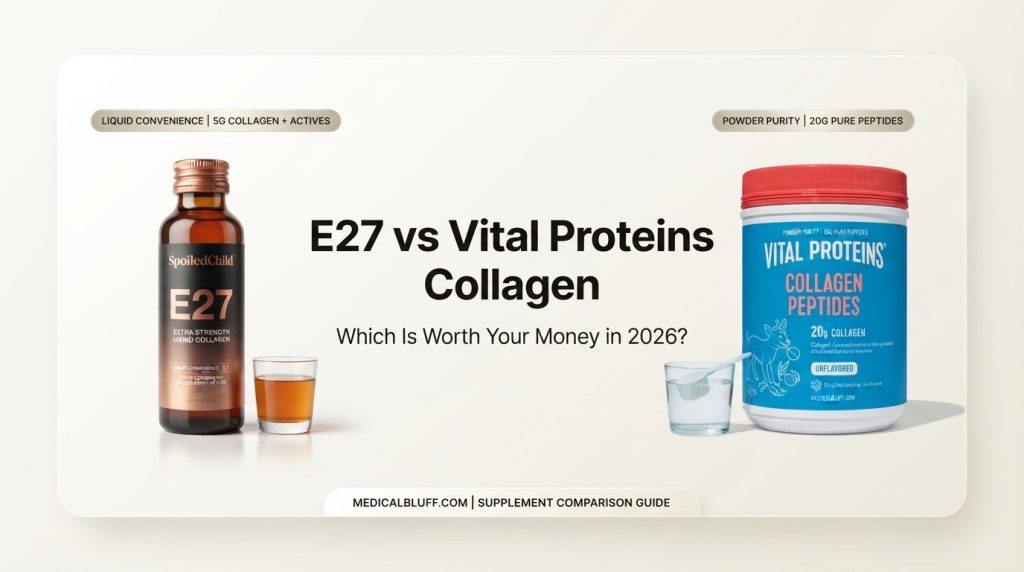
For readers comparing other popular collagen brands, our Spoiled Child vs Vital Proteins Collagen comparison examines how two different collagen products compare in their formulations and positioning.
4. How to Compare the Price of Liquid Collagen
A bottle’s price does not tell the whole story. A product may appear inexpensive because it contains more servings, while another may provide more collagen in each serving.
Two calculations make comparisons more useful.
Cost per serving
Total product price ÷ number of servings.
Cost per 10 g of collagen
Cost per serving ÷ collagen grams per serving × 10.
Using the November 2026 price snapshots:
| Product | Approximate price snapshot | Servings | Cost per serving | Cost per 10 g |
|---|---|---|---|---|
| NatureWise | $19.19 | 30 | $0.64 | $1.60 |
| Zena | $34.99 | Pack-dependent | Verify exact pack | Not comparable until verified |
| Youtheory | $16.79 | 12 | $1.40 | $2.80 |
| Momentous | $44.99 | 15 | $3.00 | $3.00 |
| Swedish Collagen | $95.20 | 30 | $3.17 | $2.54 |
These are historical price snapshots, not live quotations. Zena is excluded from the per-10-g comparison because the pack-size discrepancy makes a single serving calculation unreliable.
Cost per 10 g is a shopping comparison, not a clinical quality score. It does not account for peptide composition, research, testing, added ingredients, or individual suitability.
A less expensive product may offer better value for one buyer, while another buyer may prefer a product with a particular ingredient or certification.
5. Marine vs. Bovine Collagen: Which Is Better?
Marine and bovine collagen are both used in dietary supplements.
It generally comes from fish skin or other fish-derived materials. It commonly supplies Type I collagen.
Bovine collagen comes from cattle-derived materials, such as hide or bone, and commonly supplies Type I and Type III collagen.
Type I collagen is abundant in skin, bone, tendons, and connective tissue. Type III is also present in skin and other connective tissues. These type labels describe collagen forms; they are not a simple quality ranking.
There is not enough convincing clinical evidence to conclude that marine collagen consistently produces better skin outcomes than bovine collagen when the formulations and doses are comparable.
The choice may therefore come down to:
- Fish allergy or dietary restrictions.
- The exact collagen source.
- Ingredient transparency.
- Peptide formulation.
- Price and serving size.
- Personal preferences.
Collagen is animal-derived. It is not suitable for a vegan diet. Anyone who requires halal or kosher certification should check the actual product and its certification rather than relying on the words “marine” or “grass-fed.”
6. Liquid Collagen vs. Powder: Does the Form Matter?
Liquid collagen is convenient, particularly for people who dislike mixing powders or swallowing capsules. Pre-measured shots and tubes also make serving sizes easier to track.
Powder, however, can be more economical and may provide a simpler ingredient list.
There is no strong basis for claiming that liquid collagen automatically absorbs better than powder. Both formats can contain hydrolyzed collagen peptides. The ingredient, dose, formulation, and quality matter more than the physical format alone.
For a fuller comparison, read our related guide: Liquid Collagen vs. Powder: Which Is Better?.
The practical decision is straightforward: choose the format that provides a clearly stated collagen amount, suits your routine, and offers reasonable value.
7. Can Collagen Help Hair, Nails, Bones, or Joints?
Collagen brands often advertise benefits for hair, nails, bones, and joints. The evidence is not equally strong across these outcomes.
Hair
There is not convincing clinical evidence that collagen alone reliably treats hair loss or stimulates hair growth.
Some studies investigate multi-ingredient hair supplements containing collagen alongside vitamins and minerals. Those results cannot establish that collagen itself caused any improvement.
Hair thinning after 40 can have several causes, including hormonal changes, iron deficiency, thyroid conditions, genetics, and other health issues. Persistent or sudden hair loss deserves an appropriate medical evaluation rather than reliance on collagen.
Nails
A small 2017 open-label study involving 25 participants reported improvements in nail growth and breakage after 24 weeks of collagen peptide use.
However, the study did not include a placebo group. That makes it difficult to separate a true supplement effect from normal variation or other influences.
The findings are interesting, but they are not strong proof that collagen prevents brittle nails.
Bones
A 2018 study involving postmenopausal women investigated specific collagen peptides over 12 months and reported improvements in bone mineral density compared with placebo.
This is an area worth further research, but one study does not establish collagen as a treatment for osteoporosis or a replacement for established bone-health care.
Joints
Some clinical research and meta-analyses have reported improvements in pain or function among people with knee osteoarthritis who used collagen supplements.
However, the studies vary in formulation, dose, and design. Evidence about one specific collagen product or joint condition should not be used to promise benefits from every liquid collagen formula.
For women concerned about bone or joint health, collagen should not replace appropriate assessment, exercise, nutrition, or prescribed treatment.
8. Liquid Collagen Side Effects and Safety
Collagen supplements are often tolerated, but they are not automatically suitable for everyone. The full ingredient list matters.
Biotin and blood-test interference
This is particularly important for the products in this comparison.
NatureWise contains 2,000 mcg of biotin per serving. Zena and Swedish Collagen list 5,000 mcg.
The adult adequate intake for biotin is 30 mcg daily. This is not an upper safety limit, but the amounts in these supplements are considerably higher than the adequate intake.
High-dose biotin can interfere with certain laboratory tests. Depending on the assay, it may produce misleading results in thyroid testing and cardiac troponin testing.
If you take a supplement containing biotin, tell your healthcare professional and laboratory before blood tests. Do not independently decide how long to stop it; follow the instructions from the clinician or laboratory for the specific test.
For another example of how to assess the ingredients and potential drawbacks of a branded collagen supplement, see our detailed guide: Spoiled Child Collagen Side Effects: Is E27 Safe?.
References: NIH Office of Dietary Supplements — Biotin and FDA — Biotin Interference with Troponin Tests.
Allergies and collagen source
Marine collagen is fish-derived and may be unsuitable for people with fish allergies.
Bovine collagen is derived from cattle. Check the source and manufacturing information if you have dietary or religious requirements.
Do not assume that a collagen product is free from all common allergens just because its main ingredient is collagen.
Sweeteners, sugar, and extra ingredients
Liquid products may include stevia, monk fruit, sucralose, preservatives, flavorings, or added sugar.
Some formulas also contain multiple vitamins, minerals, and botanical ingredients. A longer ingredient list is not automatically a better formula.
Review the Supplement Facts panel and the other ingredients list before purchasing.
Pregnancy and breastfeeding
There is insufficient reliable safety information for many collagen supplement formulations during pregnancy and breastfeeding.
Because these products may contain additional ingredients, it is sensible to discuss their use with a healthcare professional rather than assuming they are safe.
Medication and medical conditions
A simple collagen peptide product is different from a multi-ingredient beauty supplement. Added vitamins, minerals, and botanical ingredients may require additional consideration.
Anyone taking prescription medication or managing a medical condition should review the complete formula with a qualified healthcare professional.
9. What Should US Consumers Check Before Buying?
In the United States, dietary supplements are regulated differently from prescription medicines.
The FDA does not approve dietary supplements for safety and effectiveness before they are marketed. Manufacturers are responsible for ensuring that their products meet applicable requirements, while the FDA oversees the market and can take action when products violate the law.
That makes label reading and quality verification important.
Before buying a liquid collagen supplement, check:
- Collagen amount: Does the label state actual collagen grams or milligrams per serving?
- Serving count: Is the bottle size consistent with the number of servings?
- Source: Is the collagen bovine, marine, or another source?
- Other ingredients: Does the product contain high-dose biotin, added sugar, or unnecessary extras?
- Testing: Does the manufacturer provide meaningful third-party testing information?
- Certification: Is the exact product listed by the certifying organization?
- Price: What is the cost per serving and per 10 g of collagen?
- Retailer details: Does the listing match the exact flavor, size, and formulation shown on the manufacturer’s website?
Third-party testing is not the same as clinical proof
A certification such as NSF Certified for Sport can provide a quality-verification distinction. It does not prove that a supplement reduces wrinkles or improves hydration and skin elasticity.
Likewise, a manufacturer’s statement that a product is third-party tested does not automatically mean a consumer can inspect a batch-specific certificate of analysis.
For additional information, see the FDA’s consumer guide: It’s Really FDA Approved?.
10. Frequently Asked Questions
What is the best liquid collagen for women over 40?
There is no universally established winner. NatureWise offers a convenient 4 g serving, Zena and Youtheory include VERISOL®, Momentous has an NSF Certified for Sport distinction, and Swedish Collagen offers a marine formula. Compare the exact ingredients, serving cost, and suitability before choosing.
Is liquid collagen better than powder?
Not necessarily. There is no convincing evidence that liquid collagen is inherently more effective or better absorbed than a comparable hydrolyzed collagen powder. Convenience, formulation, dose, and price are more useful comparison points.
How much collagen should a woman over 40 take daily?
Clinical trials have investigated different amounts, often between 1 and 10 g daily. However, there is no universally established recommended daily dose specifically for women over 40. The research dose for a particular ingredient should not be treated as an individualized prescription.
Does collagen reduce wrinkles?
Some trials report improvements in selected skin measurements, including hydration and elasticity. However, the evidence is inconsistent, and high-quality or independently funded studies have not consistently demonstrated benefits. Collagen should not be expected to remove wrinkles.
Is marine collagen better than bovine collagen?
There is insufficient convincing clinical evidence to say that marine collagen consistently produces better skin results. Source, peptide formulation, dose, allergens, and product quality all matter.
How long does liquid collagen take to work?
Some studies have assessed skin outcomes after eight to twelve weeks. That is a research assessment period, not a guarantee that a consumer will see results within that time. Individual responses may differ, and some people may notice no meaningful change.
Can collagen supplements interfere with blood tests?
Collagen itself is not the main concern in the products discussed here. Added high-dose biotin can interfere with certain laboratory tests, including some thyroid and cardiac troponin assays. Always tell your healthcare professional and laboratory about supplements you take.
Is collagen worth taking after menopause?
That depends on the reason for taking it, the product, cost, and expectations. Evidence for skin benefits remains uncertain. Collagen should not replace established care for osteoporosis, significant hair loss, or other medical conditions.
Bottom Line: Choose the Formula, Not the Biggest Number
The best liquid collagen for women over 40 is not necessarily the product with the highest collagen dose or the most impressive marketing claims.
A useful buying decision starts with the actual collagen amount, source, formulation, price, additional ingredients, and quality verification. A 2.5 g product containing a specific studied peptide should not automatically be dismissed, just as a 12.5 g product should not automatically be considered superior.
The clinical evidence offers some encouraging findings for skin hydration and elasticity, but important research limitations remain. There is not enough reliable evidence to promise wrinkle removal, restored firmness, or reversal of skin aging.
For women considering collagen, realistic expectations and careful product selection matter more than chasing the highest milligram count.
MedicalBluff’s position: Evidence over hype.
References
- Pu SY, et al. Effects of Oral Collagen for Skin Anti-Aging: A Systematic Review and Meta-Analysis. 2023. PubMed Central
- Myung SK, Park Y. Effects of Collagen Supplements on Skin Aging: A Systematic Review and Meta-Analysis of Randomized Controlled Trials. The American Journal of Medicine. 2025. PubMed
- Effects of Collagen-Based Supplements on Skin’s Hydration and Elasticity: A Systematic Review. 2025. PubMed
- Oral Collagen Peptides and Skin Rejuvenation: An Updated Meta-Analysis of Randomized Controlled Trials. 2026. PubMed Central
- Grimes DR, Mahto A. Hydrolyzed Collagen for Skin Aging Meta-Analyses Are Unreliable. Journal of Cosmetic Dermatology. 2026. Wiley
- Proksch E, et al. Oral Supplementation of Specific Collagen Peptides Has Beneficial Effects on Human Skin Physiology: A Double-Blind, Placebo-Controlled Study. 2014. PubMed
- Proksch E, et al. Oral Supplementation of Specific Bioactive Collagen Peptides Reduces Skin Wrinkles and Increases Dermal Matrix Synthesis. 2013. PubMed
- Hexsel D, et al. Oral Supplementation with Specific Bioactive Collagen Peptides Improves Nail Growth and Reduces Symptoms of Brittle Nails. 2017. PubMed
- König D, et al. Specific Collagen Peptides Improve Bone Mineral Density and Bone Markers in Postmenopausal Women. 2018. PubMed
- NIH Office of Dietary Supplements. Biotin: Fact Sheet for Health Professionals. NIH
- US Food and Drug Administration. Biotin Interference with Troponin Lab Tests. FDA
- US Food and Drug Administration. It’s Really FDA Approved? FDA
- National Sanitation Foundation. Dietary Supplements and Functional Foods FAQs. NSF
- NatureWise. Liquid Collagen Product Information. Manufacturer
- Zena Nutrition. Liquid Collagen + Biotin. Manufacturer
- Youtheory. Collagen Liquid. Manufacturer
- Momentous. Collagen Shot. Manufacturer
- Swedish Collagen. Collagen Deluxe Shots. Manufacturer
Product prices, pack sizes, formulas, and availability can change. Verify the current Supplement Facts panel and checkout price before purchase.